Giordano Bruno was born Filippo Bruno in 1548 in Nola, a small town near Naples in the Kingdom of Naples. His life would become one of the most tragic and inspiring stories of the Renaissance—a tale of intellectual courage that ended in flames but left an indelible mark on free thought.
At fifteen, Bruno entered the Dominican Order in Naples, taking the name Giordano. The Dominicans provided him with an exceptional education in Aristotelian philosophy and theology, but the young friar’s restless mind soon led him into dangerous territory. He began questioning orthodox Catholic doctrine, including transubstantiation and the veneration of saints. By 1576, facing charges of heresy, Bruno fled the monastery and began a life of perpetual wandering that would last until his death.
For the next sixteen years, Bruno traveled across Europe—Geneva, Toulouse, Paris, London, and various German cities—teaching, writing, and developing his revolutionary cosmological and philosophical ideas. In England, where he spent two formative years (1583-1585), he found temporary refuge and intellectual companionship, publishing some of his most important works. He lectured at Oxford and engaged with the Elizabethan court, though his abrasive personality and radical ideas often created enemies as quickly as admirers.
In 1591, Bruno made a fateful decision to return to Italy, lured by an invitation from the Venetian nobleman Giovanni Mocenigo to teach him the art of memory. This would prove to be a trap. Mocenigo, disappointed that Bruno would not reveal what he considered magical secrets, denounced him to the Venetian Inquisition in 1592. Bruno was arrested and eventually transferred to Rome, where he spent eight years imprisoned by the Roman Inquisition.
Throughout his trial, Bruno refused to recant his philosophical positions. On February 17, 1600, he was burned at the stake in the Campo de’ Fiori in Rome. According to witnesses, when the sentence was read, Bruno responded defiantly: “Perhaps you pronounce this sentence against me with greater fear than I receive it.” A statue now stands in that square, commemorating the man who chose death over moral surrender.
The infinite universe and cosmic philosophy
Bruno’s most revolutionary contribution was his vision of an infinite universe. While Copernicus had placed the Sun at the center of our planetary system, Bruno went dramatically further. He proposed that the universe had no center at all—that the stars were distant suns, each potentially surrounded by their own planets, and that this cosmic expanse extended infinitely in all directions.
This was not merely astronomical speculation; it was a complete reimagining of humanity’s place in existence. Bruno argued that countless worlds existed throughout the infinite universe, many potentially harboring life. He rejected the Aristotelian notion of a hierarchical cosmos with Earth at the center, enclosed by crystalline spheres. Instead, he envisioned a boundless, homogeneous universe governed by the same natural laws everywhere—a concept that would not be scientifically vindicated until centuries later.
Bruno’s infinite cosmos was intimately connected to his theological views. He saw the infinite universe as a necessary manifestation of an infinite God. A truly infinite deity, he argued, could only express itself through an infinite creation. This led him to a form of pantheism—the belief that God and nature are one, that divinity permeates all of existence rather than existing as a separate creator outside the universe.
The art of memory and cognitive magic
Bruno was fascinated by the classical art of memory, a mnemonic technique dating back to ancient Greece and Rome. However, he transformed this practical tool into something far more mystical and profound. In works like De umbris idearum (The Shadow of Ideas) and Ars memoriae (The Art of Memory), Bruno developed elaborate memory systems based on magical and hermetic principles.
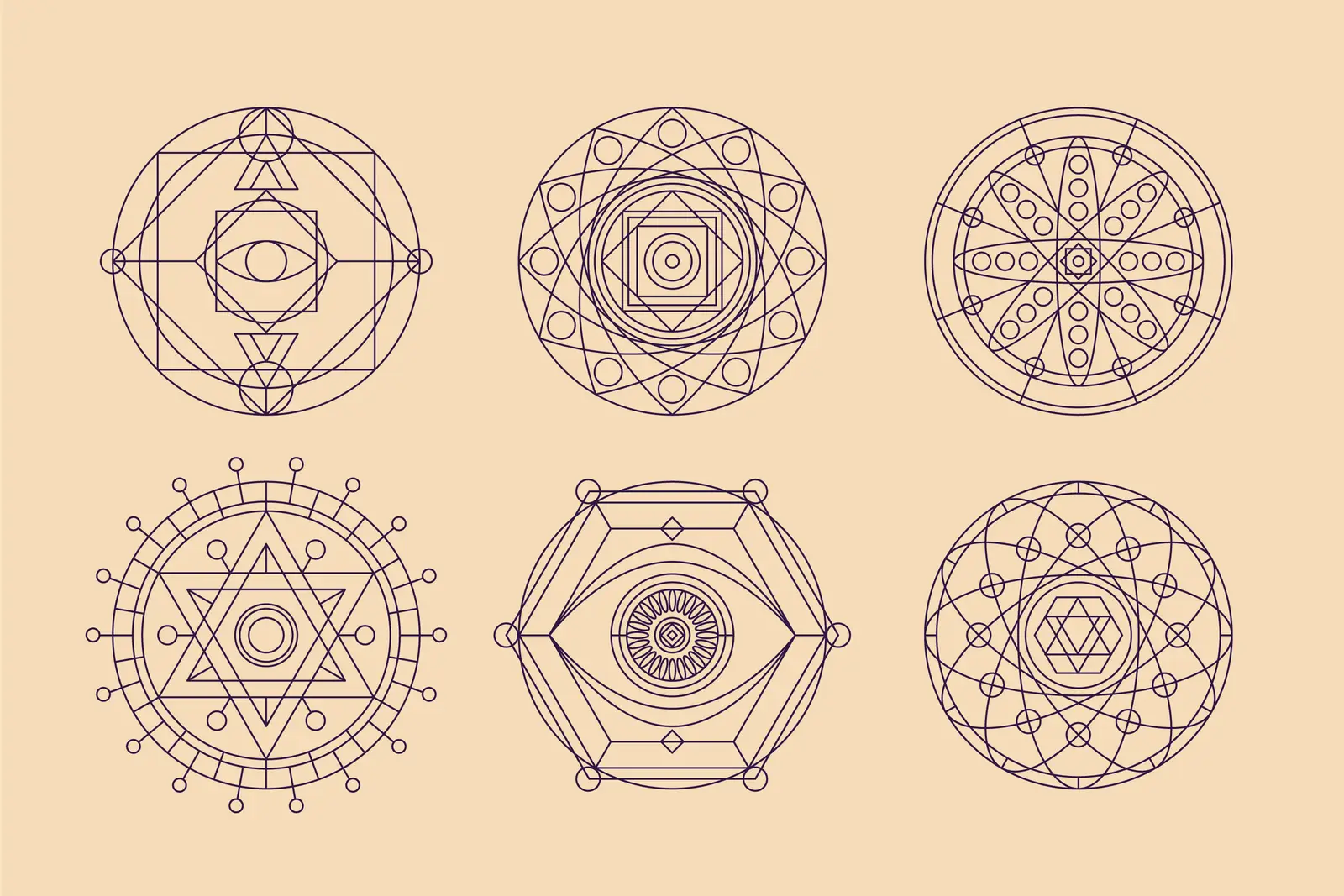
His memory systems used complex visual wheels, diagrams, and symbolic images derived from Renaissance hermeticism, astrology, and Neoplatonism. These weren’t merely devices for remembering information; Bruno believed they could align the human mind with cosmic forces and ultimate reality. By imprinting certain archetypal images on the imagination, practitioners could supposedly access higher levels of consciousness and truth.
This “cognitive magic” reflected Bruno’s belief in the intimate connection between the microcosm (the human mind) and the macrocosm (the universe). The trained memory became a theater where cosmic truths could be represented and manipulated, allowing the philosopher to participate in the divine intelligence that animated all things.
Hermetic philosophy and religious syncretism
Bruno was deeply influenced by hermeticism, a philosophical and religious tradition based on writings attributed to Hermes Trismegistus. These texts, which Renaissance scholars believed were ancient Egyptian wisdom predating Moses, actually dated from the early Christian era. Nevertheless, they profoundly shaped Bruno’s worldview.
From hermeticism, Bruno drew his concept of an animated universe pervaded by divine spirit. He believed in a “world soul” (anima mundi) that connected all things in a living, organic cosmos. This led him to reject the mechanical view of nature that would later dominate scientific thought, instead seeing the universe as a vast, living organism infused with intelligence and purpose.
Bruno’s religious views were radically syncretic. He saw truth in many religious traditions—ancient Egyptian religion, which he believed was the purest expression of natural religion, as well as Christianity, which he thought had been corrupted by institutional dogma. He called for a return to what he considered the pristine philosophical religion of the ancient world, stripped of superstition and focused on the direct experience of the divine in nature.
This religious vision made him deeply critical of all established churches. He attacked the Catholic Church’s corruption and dogmatism but was equally dismissive of Protestant reformers, whom he saw as narrow-minded and intellectually limited. His vision of a universal, natural religion transcending sectarian boundaries was centuries ahead of its time.
The coincidence of opposites and dialectical thinking
Drawing on the work of Nicholas of Cusa, Bruno developed a sophisticated dialectical philosophy centered on the concept of the “coincidence of opposites” (coincidentia oppositorum). He argued that at the infinite level—the level of God and ultimate reality—all opposites merge and become identical.
In the infinite universe, Bruno reasoned, there is no absolute up or down, no absolute center or periphery. Maximum and minimum coincide. The infinitely large and the infinitely small meet in the infinite. This wasn’t merely paradoxical wordplay; it represented a fundamental insight into the nature of reality beyond finite human categories.
This principle extended to his theory of monads—the ultimate constituents of reality. Each monad was simultaneously a unity and a multiplicity, containing within itself the pattern of the whole universe. The One and the Many were ultimately the same. This anticipates later philosophical developments, including aspects of Leibniz’s monadology and Spinoza’s substance monism, as well as Hegel’s dialectical logic.
Ethics of heroic enthusiasm
Bruno’s ethical philosophy centered on what he called “heroic enthusiasm” or “heroic frenzy” (De gli eroici furori). This was a passionate, almost erotic striving toward union with the infinite and divine. The heroic philosopher transcends ordinary human limitations and social conventions to pursue ultimate truth.
This wasn’t a calm, detached contemplation but an intense, transformative passion. Bruno drew on Neoplatonic ideas of the soul’s ascent to the divine, but he gave this ascent a distinctly activist character. The heroic thinker doesn’t merely contemplate truth passively; they actively pursue it, transform themselves through it, and potentially transform the world.
Bruno presented himself as embodying this heroic ideal. His willingness to suffer persecution and ultimately death rather than renounce his philosophical convictions was the ultimate expression of heroic enthusiasm. He chose the infinite over the finite, truth over comfort, moral integrity over physical survival.
Magic, science and the transformation of nature
Bruno’s philosophy of magic reveals the complex relationship between Renaissance thought and the emerging scientific revolution. His “magic” wasn’t about supernatural interventions but about understanding and manipulating natural forces through deep knowledge of nature’s hidden sympathies and connections.
He believed that the wise philosopher, understanding the unity of all things and the correspondences between different levels of reality, could effect changes in the material world through knowledge. This was “natural magic“—working with nature’s own principles rather than against them. Bruno saw no sharp distinction between magic, philosophy, and what we would call science; they were all ways of understanding and engaging with the natural world.
Paradoxically, while Bruno’s magical worldview seems alien to modern science, his insistence on the unity of nature, the homogeneity of the cosmos, and the existence of natural laws operating everywhere helped prepare the ground for the scientific revolution. His infinite universe, though arrived at through philosophical and mystical reasoning, anticipated modern cosmology more than the limited Copernican system.
Bruno’s lasting impact
For centuries after his death, Bruno remained a controversial and largely marginalized figure. The Catholic Church kept his works on the Index of Forbidden Books. Enlightenment thinkers sometimes celebrated him as a martyr for free thought but often misunderstood his complex philosophical system.
In the nineteenth century, Bruno was rediscovered and celebrated, particularly in Italy where he became a symbol of resistance to religious authority and a hero of Italian nationalism. The monument erected in Campo de’ Fiori in 1889 became a focal point for secularist and anti-clerical sentiment.
Modern scholarship has revealed the full complexity of Bruno’s thought—neither simply a proto-scientist nor merely a Renaissance magus, but a unique thinker who synthesized cosmology, metaphysics, ethics, and spiritual practice into a comprehensive vision. His influence can be traced in thinkers as diverse as Spinoza, Leibniz, Schelling, and even twentieth-century philosophers of science.
Perhaps most importantly, Bruno embodied the principle that intellectual freedom and the search for truth are worth any price. In an age of renewed threats to free inquiry and expression, his courage and commitment to following his convictions wherever they led remain powerfully relevant. The forgotten sage of Nola continues to speak to all who value truth over comfort and understanding over dogma.
Selected works by Giordano Bruno
Major Philosophical Works
De umbris idearum (The Shadow of Ideas, 1582) – Bruno’s first published work on the art of memory, combining mnemonic techniques with metaphysics.
Ars memoriae (The Art of Memory, 1582) – Further development of his memory system based on magical and hermetic principles.
Cantus Circaeus (The Incantation of Circe, 1582) – Another work on memory combining classical mythology with cognitive techniques.
La cena de le ceneri (The Ash Wednesday Supper, 1584) – Written in Italian, defending the Copernican system and introducing Bruno’s ideas about the infinite universe.
De la causa, principio et uno (Concerning the Cause, Principle, and One, 1584) – A dialogue exploring Bruno’s metaphysics, the unity of being, and the nature of matter and form.
De l’infinito, universo e mondi (On the Infinite Universe and Worlds, 1584) – Bruno’s most famous cosmological work, arguing for an infinite universe with innumerable worlds.
Spaccio de la bestia trionfante (The Expulsion of the Triumphant Beast, 1584) – A moral and religious allegory critiquing corruption and calling for ethical reform.
Cabala del cavallo pegaseo (The Cabala of the Horse Pegasus, 1585) – A satirical work attacking pedantry and empty learning.
De gli eroici furori (The Heroic Frenzies, 1585) – Bruno’s ethical and spiritual philosophy, describing the soul’s passionate ascent toward the infinite.
De triplici minimo et mensura (On the Threefold Minimum and Measure, 1591) – A later work developing Bruno’s atomistic and mathematical philosophy.
De monade, numero et figura (On the Monad, Number, and Figure, 1591) – Exploring the metaphysical principles underlying reality through number and geometry.
De immenso et innumerabilibus (On the Immeasurable and Innumerable, 1591) – Bruno’s final major cosmological work, published shortly before his arrest, synthesizing his vision of the infinite universe.
Additional works and resources
Bruno wrote numerous other works during his prolific career, including comedies (Il candelaio, 1582), Latin poems, and various shorter philosophical treatises. Many of his works were written in Italian rather than Latin, making philosophy accessible to a broader audience—a radical choice for his time.
For those interested in studying Bruno’s thought, several modern editions and translations are available. Frances Yates’s groundbreaking studies, particularly Giordano Bruno and the Hermetic Tradition (1964), opened new understanding of Bruno’s philosophical context. Hilary Gatti’s Giordano Bruno and Renaissance Science (1999) examines his relationship to emerging scientific thought.
The collected Latin works were published in the early twentieth century, and many of his Italian dialogues have been translated into English. However, Bruno’s dense, allusive style and the complexity of his philosophical system make his works challenging even for specialists. Reading Bruno requires patience and some familiarity with Renaissance philosophy, hermeticism, and the intellectual context of the late sixteenth century—but the reward is encountering one of history’s most original and fearless minds.
Going further: Western Esotericism: The Secret Hermetic Arts on Udemy maps the world Bruno died for: Renaissance magic, the Corpus Hermeticum and the traditions that fed them. Affiliate link — Born To Be Free earns a commission if you enrol, at no extra cost to you.