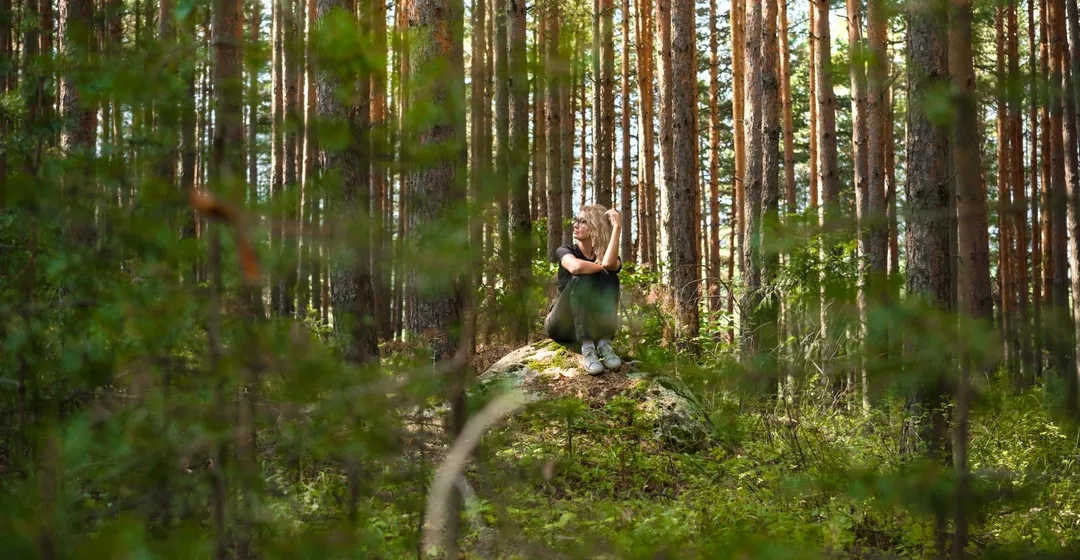
There is a forest, and then there is a forest. You can walk through one as a pedestrian — noticing shapes, filling your lungs, checking your step count. Or you can enter the other kind: the forest as a living intelligence, a web of ancient presences, each tree a distinct being with its own medicine, its own memory, its own invitation.
The Japanese have a word for the first gateway into this deeper forest: Shinrin-yoku, or forest bathing. The Celts, the druids, the tree-priests of the ancient Atlantic world had their own map. What happens when these two traditions — separated by thousands of miles and centuries of divergent culture — are placed in conversation? Something remarkable: they turn out to be pointing at the same truth.
This post is a guide to that convergence. It combines the science-backed practice of Shinrin-yoku with the symbolic and medicinal wisdom of the Celtic Ogham tree alphabet to create a genuinely transformative approach to forest connection — not just a walk in the woods, but a guided encounter with the living world.
What Shinrin-yoku Actually Is (and What It Is Not)
Shinrin-yoku is not hiking. It is not exercise. It is not even primarily meditation, though meditative states often arise. It is, in the most literal sense, a bath — an immersion of all the senses in the atmosphere of a forest.
The practice was developed in Japan in the 1980s as a response to the epidemic of stress-related illness in urban populations. What Japanese researchers discovered was stunning: spending time passively in forested environments — without specific goals, tracking devices, or performance metrics — produced measurable reductions in cortisol, blood pressure, and sympathetic nervous system activation. The immune system responded with particular enthusiasm, with studies showing significant increases in natural killer cell activity following forest immersion.
The mechanism behind this is at least partly chemical. Trees communicate with each other through a volatile organic compound system — phytoncides — which humans absorb through the skin and respiratory tract. These compounds, particularly those released by conifers and broad-leaved trees, directly influence our immune function and stress hormones. We are, in a very literal sense, receiving a chemical message from the trees when we stand among them.
But Shinrin-yoku, as it has evolved in Japan and spread globally, is more than a biohack. At its most developed, it is a practice of radical receptivity: of slowing down enough to receive what the forest is offering, rather than extracting something from it.
This is exactly where Celtic tree wisdom steps in as the perfect complement.
The Celtic Ogham: A Living Alphabet
The Ogham is one of the oldest alphabets in the British Isles, carved into stone and wood by Celtic peoples from roughly the 4th century CE, though its roots almost certainly reach much deeper into oral druidic tradition. What makes the Ogham unique among writing systems is that each of its twenty letters corresponds to a specific tree — and each tree carries a complex web of spiritual, medicinal, psychological, and seasonal meaning.
The druids, those custodians of Celtic spiritual and intellectual life, were not primarily priests in the conventional sense. They were philosophers, physicians, judges, poets, and naturalists simultaneously. Their deep knowledge of trees was not merely botanical — it was cosmological. Trees were understood as mediators between the worlds: their roots reaching into the underworld, their trunks inhabiting the present moment, their crowns touching the sky realms. To know a tree was to have a key to a door.
The combination of Shinrin-yoku’s receptive, sensory immersion with the Ogham’s specific, named wisdom about individual trees creates something like a guided initiation: you bring your open, softened nervous system to a particular tree, and you bring the lens of Celtic wisdom that helps you interpret and deepen what you receive.
Preparing for the Practice: The Shinrin-yoku Gateway
Before approaching any specific tree, the transition from ordinary consciousness to forest consciousness matters enormously. The following preparatory sequence draws directly from established Shinrin-yoku methodology:
- Leave your agenda at the treeline. This is not a workout. Silence your phone entirely — not vibrate, not do-not-disturb. Turn it face-down in your bag or leave it in the car. Time moves differently in old growth.
- Walk without destination. For the first ten to fifteen minutes, walk slowly without a fixed path. Let your feet find their own direction. This deactivates the goal-oriented prefrontal cortex and begins to engage the more receptive, sensory modes of awareness.
- Engage each sense in sequence. Pause and deliberately attend to: what you can hear (layers of sound from farthest to closest), what you can smell (especially near the soil and the bark of trees), what the air feels like on your skin, what the quality of light looks like filtering through canopy. This sequence is a reliable method for shifting from thinking-mode to sensing-mode.
- Soften your gaze. Rather than focusing sharply on objects, allow your vision to go slightly diffuse — what some traditions call soft eyes. This activates peripheral vision and, with it, a different quality of awareness.
When you feel genuinely settled — unhurried, soft, receptive — you are ready to approach a specific tree.
Five Sacred Trees: Guided Encounters
1. The Oak — Dair — Strength, Sovereignty, and the Sacred Center
In the Celtic world, the oak (Quercus robur) was not merely the most important tree — it was the axis around which the druidic cosmos turned. The word “druid” itself is thought to derive from the Proto-Indo-European root dru-, meaning oak. Sacred groves were almost invariably oak groves. The oak was the tree of the god of thunder in every Indo-European tradition from Zeus to Thor to the Irish Dagda — not coincidentally, since oaks are statistically the most frequently struck by lightning of any European tree, and thus seemed to carry a particular relationship with the sky powers.
Medicinally, oak bark is one of the great astringents of European herbal medicine — rich in tannins that tighten tissue, reduce inflammation, and support gut integrity. This astringency is itself a kind of spiritual metaphor: the oak teaches consolidation, containment, the gathering of scattered forces into a coherent center.
Guided practice: Approach a mature oak slowly. Before touching it, stand at the edge of what you sense as its energetic field — perhaps three to five meters from the trunk. Notice any change in the quality of your breath or the feeling in your chest. When you feel ready, place both palms flat against the bark. Close your eyes. The bark of an old oak is deeply textured — canyons and ridgelines under your hands. Breathe deeply and ask yourself: Where in my life do I need to find my center? Where am I dispersed that needs gathering? Remain for at least five minutes. When you step away, stand quietly for a moment and notice what has shifted.
2. The Birch — Beith — Beginnings, Purification, and the Courage of New Starts
The Ogham places the birch as its very first letter — Beith — for good reason. Birch is the pioneer species: the first tree to colonize cleared or devastated ground, the one that prepares the earth for the succession of the deeper forest. In Celtic tradition, it was associated with Imbolc, the February festival of early spring, and with the goddess Brigid — patron of healing, smithcraft, and poetry. Birth and beginnings in all their forms were under birch’s protection.
Medicinally, birch is a remarkable tree. Birch leaf tea is one of traditional European herbalism’s foremost remedies for urinary and kidney complaints, acting as a gentle diuretic and anti-inflammatory. Birch sap, harvested in early spring, is rich in xylitol and minerals and was historically consumed as a spring tonic — a first medicine after the stagnation of winter. Birch polypore mushrooms (Fomitopsis betulina), which grow almost exclusively on birch, were carried by Ötzi the Iceman 5,300 years ago, suggesting their medicinal use is prehistoric.
Guided practice: Seek out a grove of birch trees, particularly in spring when the white bark glows. Birch groves have a distinctive quality of light — they seem to glow from within. Sit with your back against a birch trunk. Bring to mind something you are trying to begin — a project, a change, a new relationship with some aspect of yourself. Feel the white bark behind you. Birch in Shinrin-yoku terms is associated with the particular quality of clean light — high, clear, unobstructed. Let that quality of lightness speak to whatever feels heavy or stuck in your beginning. The question to sit with: What would it feel like if this beginning were as natural as the birch colonizing bare earth?
3. The Rowan — Luis — Protection, Vision, and the Second Sight
The rowan (Sorbus aucuparia) holds a peculiar place in Celtic and wider European folklore: it was the tree most associated with protection against malevolent magic. Rowan was planted beside doorways, woven into cradles, and carried as amulets. In Scotland, it was sometimes called the “witch tree” — not because it was dark, but because it was considered so powerfully protective that even witches used it. This protection was understood as a form of clear-seeing: the rowan granted the ability to perceive what was hidden, to see past illusion.
The red berries of rowan are toxic raw due to parasorbic acid, but when cooked, they become the classic jelly of Scottish and Irish cuisine and a significant source of vitamin C. The tree is also one of the most important in upland ecosystems — its berries are a crucial autumn food source for birds, particularly fieldfares and redwings.
Guided practice: The rowan is often found at boundaries — the edges of forests, high moorland, rocky outcrops. Find one and notice its position. Rowan almost always grows where something ends and something else begins. Stand before it and look through its branches rather than at them, using the soft-gaze technique from your preparatory walk. The lacework of rowan branches against light is particularly striking. This is a tree for questions about discernment: What am I not seeing clearly? What am I protecting that needs protecting, and what am I defending that no longer serves me?
4. The Yew — Ioho — Death, Immortality, and Cyclical Time
The yew is perhaps the most spiritually charged tree in the entire Celtic canon — and the most biologically extraordinary. Yews are among the longest-lived organisms on Earth. The Fortingall Yew in Scotland is estimated to be between 2,000 and 5,000 years old. Individual yew trees can regenerate from their own fallen trunks, creating a ring of new growth around a hollow center — a living demonstration of death and rebirth. In Celtic tradition, the yew was the tree of both death and immortality simultaneously: Ioho, the last major letter of the Ogham, standing at the threshold.
Almost the entire yew tree is toxic — the bark, leaves, and seeds contain taxine alkaloids that are potentially lethal. The exceptions are the red berries’ flesh, which is sweet and edible (the seeds inside are toxic), and the tree’s famous pharmaceutical legacy: taxol, derived from the Pacific yew, is one of the most important chemotherapy drugs in modern oncology. Even in its medicine, the yew keeps faith with the theme of death and transformation.
Guided practice: Approach yew with particular care and intentionality. Many ancient yews grow in churchyards — testament to the fact that Christian builders knew, even if they didn’t fully acknowledge, that these sites were already sacred before the church arrived. Stand at a respectful distance and allow yourself to feel the considerable weight of the yew’s presence. This is not a tree for casual approach. Sit nearby and allow whatever thoughts or feelings about endings, losses, or transitions to surface without trying to resolve them. The yew’s gift is not consolation but perspective: in the presence of a tree that has witnessed thousands of years of human dying, our own mortality becomes something other than terrifying.
5. The Hawthorn — Huath — Boundaries, the Fairy World, and Heart Medicine
The hawthorn (Crataegus monogyna) is one of the most contradictory trees in Celtic tradition: beloved and feared simultaneously. Solitary hawthorns growing on hills or at field boundaries were considered fairy trees — the homes of the otherworldly Sídhe — and to cut one down was to invite serious misfortune. Entire road construction projects in Ireland have historically been re-routed to avoid disturbing lone hawthorns. Yet hawthorn flowers, called May blossom, were the symbol of the Beltane festival and erotic spring energy.
Hawthorn’s medicinal properties are among the best-documented of any tree in European herbal tradition and have been extensively validated by modern research. Hawthorn berry extract is widely used in European herbal medicine as a cardiovascular tonic, with evidence supporting its role in improving heart function, reducing blood pressure, and supporting coronary circulation. It is, literally and symbolically, a tree for the heart.
Guided practice: Find a hawthorn in blossom if possible — the scent of hawthorn flowers is unforgettable, honeyed and slightly feral simultaneously. This is a tree that marks edges: of fields, of open land and forest, of the human world and the otherworld. Sit beneath it and place one hand over your heart. Notice your heartbeat. In the Shinrin-yoku tradition, hawthorn environments tend to produce feelings of bittersweet tenderness — the heart softened and opened simultaneously. The question for hawthorn: What does my heart know that my mind has been too busy to listen to?
Closing the Practice: The Return
Leaving the forest is as important as entering it. Before you walk back to the ordinary world, stand still for a moment and offer some form of acknowledgment to the trees you visited. This need not be religious or even verbal — a simple pause of genuine gratitude, a hand briefly placed on bark, is sufficient.
The Shinrin-yoku tradition recommends a slow re-entry: sitting at the forest edge before returning to your vehicle, allowing the body’s recalibrated nervous system to consolidate what it has received. The Celtic tradition might frame this differently but arrives at the same place: the threshold is sacred; cross it consciously.
The trees will be there when you return. They always have been.
External Links
- Association of Nature and Forest Therapy — leading international body for certified forest therapy guides
- The Ogham Alphabet – University College Cork CELT project — scholarly resource on Celtic manuscript traditions
- Phytoncides research overview – NIH PubMed — foundational study on phytoncides and NK cell activity by Qing Li et al.
- Hawthorn for heart failure – Cochrane Review — evidence base for hawthorn cardiovascular use
- The Tree Alphabet – Blamires, “Celtic Tree Mysteries” — accessible guide to Ogham tradition for practitioners
Going further: Forest Bathing: A Mindful Escape into Nature’s Medicine on Udemy teaches the sensory practice and the research behind it, for woods rather nearer than a Celtic grove. Affiliate link — Born To Be Free earns a commission if you enrol, at no extra cost to you.