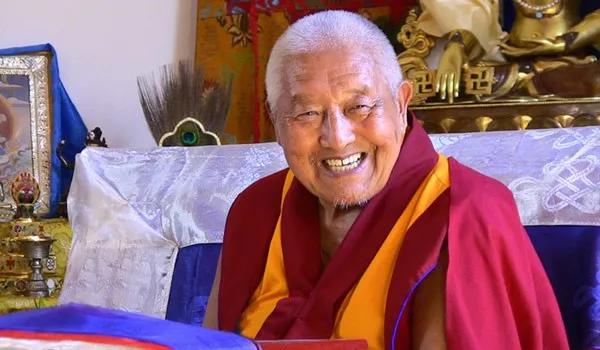
A living bridge between ancient wisdom and modern times
In the vast landscape of Tibetan spiritual masters, few figures shine as brightly as Lopön Tenzin Namdak Rinpoche. As one of the most senior and accomplished teachers of the Bön tradition—Tibet’s ancient pre-Buddhist spiritual heritage—Rinpoche has dedicated his remarkable life to preserving and transmitting wisdom that stretches back thousands of years. His journey from the mountains of eastern Tibet to becoming a global spiritual teacher represents not just a personal odyssey, but the survival story of an entire tradition.
Early life in Tibet
Lopön Tenzin Namdak was born in 1926 in Khyungpo Karu, a region in Kham, eastern Tibet. From his earliest years, his destiny seemed intertwined with the spiritual path. At the tender age of seven, he entered the local Bön monastery of Tingchen, beginning what would become a lifetime of intensive study and practice.
His spiritual education deepened when he moved to Menri Monastery in central Tibet at age thirteen. Menri, founded in 1405, was the principal seat of Bön learning—a Harvard and Oxford combined for the Bön tradition. Here, young Tenzin Namdak immersed himself in the classical curriculum of Buddhist philosophy, logic, cosmology, and ritual practice. His exceptional intelligence and dedication became evident early on, and he completed the rigorous geshe degree (roughly equivalent to a doctorate in Buddhist philosophy) at the remarkably young age of twenty-four.
But his education didn’t stop with academic achievement. He spent years engaged in solitary meditation retreats in caves and remote hermitages, where theoretical knowledge was transformed into direct experiential realization. This balance between scholarly learning and contemplative practice would become a hallmark of his teaching style.
Exile and the work of preservation
The Chinese invasion of Tibet in 1950 and the subsequent upheaval fundamentally altered the course of Tenzin Namdak’s life. In 1959, as the political situation became untenable, he made the difficult decision to flee Tibet, joining the exodus of refugees crossing the Himalayas into India. He was thirty-three years old, and he carried with him not just memories, but an entire tradition that faced potential extinction.
The early years in exile were extraordinarily challenging. Rinpoche, along with other Bön masters, found themselves in a refugee camp in northern India, struggling with poverty, disease, and an uncertain future. Yet from these desperate circumstances emerged a remarkable determination: the Bön tradition would not be allowed to disappear.
In 1967, His Holiness the 33rd Menri Trizin (the head of the Bön tradition) asked Tenzin Namdak to serve as the principal teacher at the newly established Bön Dialectic School in Dolanji, Himachal Pradesh. This request would define the rest of his life. For decades, Rinpoche poured his energy into educating a new generation of Bön practitioners, often teaching for ten to twelve hours a day. He personally trained hundreds of monks and nuns, ensuring that the vast corpus of Bön knowledge—which includes philosophy, meditation, ritual, medicine, astrology, and art—would survive into the modern era.
His commitment went beyond mere teaching. He worked tirelessly to recover and preserve Bön texts, many of which had been lost or destroyed in Tibet. He established relationships with Western scholars and practitioners, helping to introduce Bön teachings to a global audience for the first time in history.
Core teachings: the heart of Bön wisdom
Dzogchen: the Great Perfection
At the pinnacle of Lopön Tenzin Namdak’s teachings stands Dzogchen, known in Tibetan as “the Great Perfection” or “the Great Completion.” This represents the highest and most direct path within the Bön tradition—a way of recognizing one’s primordial nature that is already perfect, already enlightened, already free.
Dzogchen in the Bön tradition predates its Buddhist counterpart, according to traditional histories, and Rinpoche is considered one of the greatest living masters of this profound system. His Dzogchen teachings emphasize:
Recognition of Rigpa: Rigpa, or “pure awareness,” is the natural state of mind—clear, luminous, and free from conceptual elaboration. Rinpoche teaches that this awareness is not something to be created or achieved, but rather recognized as what has always been present. His pointing-out instructions help students directly experience this nature beyond intellectual understanding.
The Three Series: Rinpoche transmits the complete Dzogchen teachings organized into three progressive series: Semde (Mind Series), Longde (Space Series), and Mengagde (Secret Instruction Series). The Mengagde, which includes practices like Tögal (leap-over) and Trekchö (cutting through), represents the most direct methods for achieving realization and even the Rainbow Body—the complete dissolution of the physical body into light at death.
Integration with Daily Life: Unlike some mystical systems that require complete renunciation, Rinpoche emphasizes that Dzogchen practice should permeate every aspect of life. Whether eating, working, or relating to others, one can remain in the natural state of awareness.
The Nine Ways of Bön
Rinpoche’s teachings encompass the entire graduated path of Bön, traditionally organized into Nine Ways or vehicles:
- The Way of Prediction (Chashen): Divination, astrology, and prognostication
- The Way of the Visual World (Nangshen): Understanding the phenomenal world and elemental forces
- The Way of Illusion (Trulshen): Working with energy and transformation
- The Way of Existence (Sichen): Practices related to death, dying, and the afterlife
- The Way of Lay Practitioners (Genyen): Ethics and practices for householders
- The Way of Monks (Drangsong): Monastic discipline and renunciation
- The Way of Primordial Sound (A-kar): Meditation on sound and mantra
- The Way of Primordial Shen (Yechen): Advanced tantric practices
- The Supreme Way (Lamed): Dzogchen, the pinnacle teaching
Rinpoche has worked extensively to ensure all these levels are preserved and taught systematically, from beginning practices to the highest realizations.
Compassion and Bodhicitta
While Dzogchen represents the pinnacle of wisdom teachings, Rinpoche equally emphasizes compassion and bodhicitta—the awakened heart that wishes for all beings to be free from suffering. He teaches that:
- Wisdom without compassion is incomplete: Pure awareness must express itself as love and compassion for all beings. The recognition of one’s own nature naturally leads to recognizing the same potential in all others.
- Relative and absolute bodhicitta: Students should cultivate both the conventional practices of loving-kindness and compassion (relative bodhicitta) and the direct recognition of the empty, luminous nature of phenomena (absolute bodhicitta).
- Service to others: Rinpoche’s own life exemplifies this teaching—despite achieving high realization, he has spent decades in tireless service to students and the Bön tradition.
The Zhang Zhung language and culture
One of Rinpoche’s unique contributions has been his work preserving the ancient Zhang Zhung language and culture. Zhang Zhung was the kingdom in western Tibet where Bön flourished before the seventh century. The language is now extinct as a spoken tongue, but it remains crucial for understanding the oldest Bön texts.
Rinpoche is one of the last living masters with deep knowledge of Zhang Zhung, and he has worked with scholars to document the language, create dictionaries, and translate key texts. This work represents cultural preservation of the highest order—saving not just words, but an entire worldview and spiritual framework.
Meditation Practices
Rinpoche teaches a comprehensive array of meditation practices:
Shamatha (Calm Abiding): Foundational practices for stabilizing attention and calming the mind. These include following the breath, focusing on objects, and developing concentration.
Vipassana (Insight): Analytical meditations examining the nature of phenomena, the self, and reality. These practices deconstruct our ordinary assumptions and lead to liberating insights.
Guru Yoga: Devotional practices connecting with enlightened masters, particularly Tonpa Shenrab (the founder of Bön) and the lineage masters. This practice generates blessing and opens the heart.
Deity Practices: Visualization and mantra recitation involving Bön deities, which purify obscurations and cultivate specific qualities like compassion, wisdom, and protection.
Chöd: The practice of “cutting through” ego-clinging, often performed in frightening places like charnel grounds. This advanced practice uses visualization, music, and meditation to sever attachment to the body and self.
Rushen: Preliminary Dzogchen practices that separate ordinary confused mind from pure awareness through vigorous physical and mental exercises.
Teaching style and approach
Those who have studied with Lopön Tenzin Namdak consistently describe several distinctive qualities of his teaching:
Clarity and Precision: Despite the profound and often ineffable nature of Dzogchen teachings, Rinpoche explains complex concepts with remarkable clarity. His decades of scholarly training enable him to articulate subtle points of philosophy and practice precisely.
Authenticity: Rinpoche teaches from direct personal experience, not merely from books. His decades of meditation practice and retreats give his words unmistakable authority.
Adaptability: While maintaining the integrity of traditional teachings, Rinpoche has shown remarkable ability to communicate with Western students, understanding their questions and concerns.
Humor and Warmth: Despite his scholarly accomplishments and spiritual realization, Rinpoche is known for his accessibility, humor, and warm human presence. He doesn’t take himself too seriously, even while treating the teachings with utmost respect.
Rigor: Rinpoche expects serious commitment from students. He doesn’t dilute teachings or offer “quick fixes.” The path he presents requires dedication, practice, and patience.
Literary contributions
Beyond oral teachings, Lopön Tenzin Namdak has made significant contributions to preserving Bön literature:
- He has written numerous texts on philosophy, meditation, and ritual
- He has edited and published many ancient Bön scriptures
- He collaborated with Western scholars like John Myrdhin Reynolds to produce English translations of key Bön texts
- His works on Dzogchen, including commentaries on the Zhang Zhung Nyan Gyud (the most important Dzogchen text in Bön), are considered authoritative
These literary efforts ensure that even when oral transmission faces challenges, the written teachings remain accessible to future generations.
Global impact and legacy
Since the 1960s, Rinpoche has traveled extensively throughout Europe, America, and Asia, establishing Bön centers and study groups worldwide. His efforts have resulted in:
- Serenity Ridge Retreat Center in Virginia, USA, which serves as a major hub for Bön practice in the West
- Numerous Bön centers throughout Europe, particularly in Austria, Germany, Italy, France, and Poland
- Recognition of Bön as a legitimate fifth school of Tibetan Buddhism (alongside Nyingma, Kagyu, Sakya, and Gelug)
- Academic study of Bön at major universities
- A growing community of Western Bön practitioners who never would have encountered these teachings otherwise
Perhaps most significantly, Rinpoche has ensured that younger Tibetan teachers have been trained to continue the transmission. The Bön tradition, which faced potential extinction in the 1960s, now has a stable institutional foundation and a global presence.
Teachings for modern times
What makes Lopön Tenzin Namdak’s teachings particularly relevant for contemporary practitioners?
Direct experience over dogma: In an age skeptical of religious authority, Rinpoche emphasizes direct personal experience of truth rather than blind faith. Dzogchen, in particular, invites practitioners to “taste” awareness for themselves.
Integration, not escape: Rather than requiring withdrawal from the world, the teachings show how to work with modern life—jobs, relationships, technology—as the very path of practice.
Psychological insight: The meditation practices and philosophical teachings offer profound psychological insights into the nature of mind, suffering, and happiness that resonate with modern psychology while going far beyond it.
Ecological wisdom: Bön teachings on the elements, nature spirits, and the interconnection of all life offer a spiritual framework for environmental awareness and action.
Cultural preservation: In a globalizing world where indigenous traditions face extinction, Rinpoche’s work demonstrates the value of maintaining diverse spiritual heritages.
The living example
Perhaps Lopön Tenzin Namdak’s greatest teaching is his life itself. Now in his late nineties, he continues to teach and guide students with undiminished clarity and compassion. His life demonstrates:
- Resilience: Surviving immense loss and hardship without losing faith or purpose
- Dedication: Decades of selfless service to preserve tradition and help others
- Humility: Remaining approachable and unpretentious despite extraordinary accomplishments
- Joy: Maintaining humor, warmth, and appreciation for life’s simple pleasures
- Integration: Embodying the teachings rather than merely teaching them
Students often report that simply being in Rinpoche’s presence communicates something beyond words—a quality of awareness, peace, and authenticity that points to what the teachings describe.
Conclusion: a light in challenging times
Lopön Tenzin Namdak Rinpoche represents a rare convergence of scholarly mastery, meditative realization, and compassionate action. His life spans one of the most tumultuous periods in Tibetan history, yet he has transformed tragedy into opportunity, exile into expansion, and loss into renewal.
For those interested in exploring the depths of consciousness, understanding the nature of mind, or finding a path of genuine spiritual transformation, Rinpoche’s teachings offer a complete system—ancient in origin yet timeless in application. The Bön tradition he has worked so hard to preserve offers wisdom on everything from daily ethics to the highest mystical realization.
As the world faces increasing complexity, fragmentation, and uncertainty, the teachings Lopön Tenzin Namdak transmits seem more relevant than ever. They offer a path to discovering the peace, clarity, and compassion that reside at the core of human nature—a discovery that benefits not only individual practitioners but radiates outward to all they encounter.
In preserving and sharing these teachings, Rinpoche has ensured that a precious spiritual heritage will continue to illuminate the way for countless beings seeking liberation. His legacy is not merely historical but living—present in every student who practices, in every center established, in every text preserved, and in every moment someone recognizes the clear light of their own true nature.
The teachings of Lopön Tenzin Namdak Rinpoche remind us that no matter how dark the times, the lamp of wisdom can continue to burn, passed carefully from hand to hand across the generations, lighting the way home.