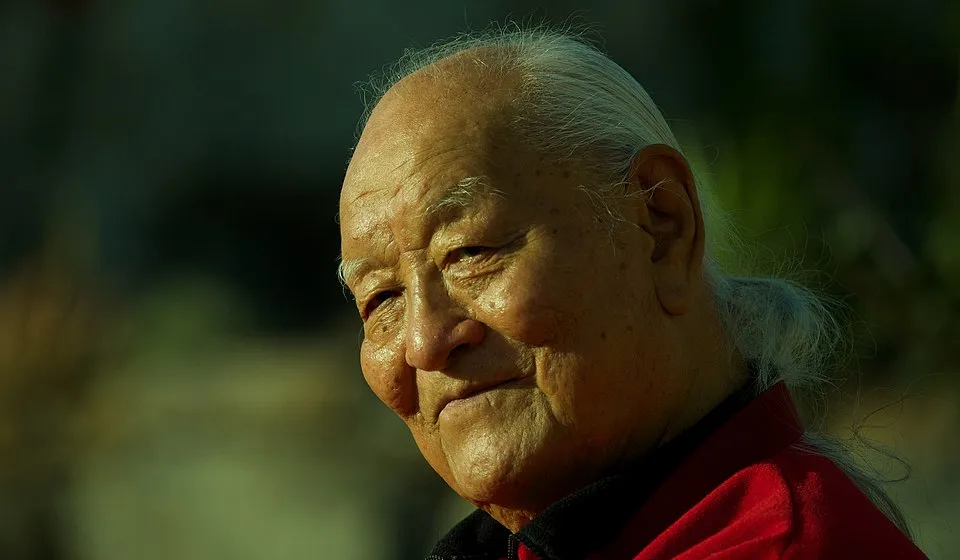
Introduction of Chögyal Namkhai Norbu Rinpoche
Chögyal Namkhai Norbu Rinpoche (1938-2018) stands as one of the most influential Tibetan Buddhist masters of the modern era, particularly renowned for his profound transmission of Dzogchen teachings to the Western world. His life embodied a rare synthesis of traditional spiritual mastery and contemporary engagement, bridging ancient Tibetan wisdom with the practical needs of modern practitioners across cultures.
Early life and recognition
Born on December 8, 1938, in Derge, eastern Tibet, Namkhai Norbu was recognized at an early age as the reincarnation of the renowned Dzogchen master Adzom Drugpa. His recognition came not once but twice—he was also identified as a reincarnation of Ngawang Namgyal, the founder of Bhutan’s religious and civil government. This dual recognition was highly unusual and signaled the extraordinary spiritual capacity he would demonstrate throughout his life.
From childhood, Namkhai Norbu received extensive training in both the Nyingma and Sakya schools of Tibetan Buddhism. He studied with some of the greatest masters of his time, including his root teacher Rigdzin Changchub Dorje, from whom he received the complete transmission of Dzogchen Ati Yoga. His education was comprehensive, encompassing Buddhist philosophy, tantric practices, Tibetan medicine, astrology, and the traditional arts and sciences of Tibet.
Journey to the West
In 1960, facing the political upheaval in Tibet following the Chinese invasion, Namkhai Norbu accepted an invitation from renowned Tibetologist Giuseppe Tucci to work at the Institute of Middle and Far Eastern Studies (IsMEO) in Rome, Italy. This move would prove fateful, not only preserving his freedom to teach but also positioning him to become one of the first Tibetan masters to establish a significant presence in the West.
Rather than establishing himself solely as a religious figure, Namkhai Norbu pursued an academic career, teaching Tibetan and Mongolian language and literature at the University of Naples “L’Orientale” from 1962 until his retirement in 1992. This academic foundation allowed him to communicate Dzogchen teachings in ways that were accessible to Western minds, bridging traditional spiritual language with contemporary understanding.
The Dzogchen Community
In 1976, Namkhai Norbu founded the first Dzogchen Community at Merigar West in Arcidosso, Tuscany, Italy. This marked the beginning of an international network that would eventually span the globe. Unlike traditional monastic institutions, these communities were designed for lay practitioners living ordinary lives—people with families, jobs, and worldly responsibilities who nonetheless sought authentic spiritual practice.
The Dzogchen Community grew to include major centers on every continent: Merigar West and Merigar East (Romania) in Europe, Tsegyalgar East and West in the United States, Tashigar Norte (Venezuela) and Tashigar Sur (Argentina) in South America, and Namgyalgar in Australia, among many other smaller groups worldwide. This global network became a living testament to the universal applicability of Dzogchen teachings beyond cultural and geographical boundaries.
Core teachings: the essence of Dzogchen
The Nature of Mind
At the heart of Namkhai Norbu’s teaching was Dzogchen, the “Great Perfection“, considered the highest and most direct teaching in Tibetan Buddhism. Central to this approach is the recognition of the primordial state of the individual—the natural condition of mind that is already perfect, already enlightened, requiring not transformation but simply recognition.
Namkhai Norbu consistently emphasized that Dzogchen is not a religious doctrine or philosophical system but rather direct knowledge of one’s true nature. He taught that every being possesses this fundamental nature, which he called the “base” (gzhi in Tibetan). This base is characterized by emptiness (essence), clarity (nature), and unobstructed compassionate energy (capacity). The spiritual path, therefore, is not about becoming something new but recognizing what has always been present.
The three series of Dzogchen
Namkhai Norbu transmitted the complete Dzogchen teachings through its three series:
Semde (Mind Series): This approach works with recognizing the nature of mind through mental contemplation and understanding. It emphasizes observing the mind’s nature directly, seeing thoughts arise and dissolve without grasping or rejecting them.
Longde (Space Series): These teachings focus on the experience of spaciousness and the inseparability of emptiness and clarity. Practitioners work with specific positions and gazes to discover the natural state through the dimension of space.
Mennagde or Upadesa (Secret Instruction Series): The most direct teachings, these instructions work with the body’s energy and the nature of vision itself. This includes the profound practices of Tögal (Direct Leap) and Trekchö (Cutting Through), which reveal the natural state through direct experience rather than gradual development.
Integration into daily life
One of Namkhai Norbu’s most significant contributions was his emphasis on integrating practice into everyday life. He repeatedly taught that Dzogchen is not separate from ordinary existence but is discovered within it. He encouraged students to maintain awareness in all activities—working, eating, relating to others—rather than compartmentalizing spiritual practice into isolated meditation sessions.
He often said, “Dzogchen is not a religion; it is our real condition.” This statement encapsulated his teaching that awakening is not about adopting new beliefs or performing rituals, but about living authentically from one’s true nature in every moment.
Yantra Yoga and the body
Recognizing the importance of the body in spiritual practice, Namkhai Norbu extensively taught Yantra Yoga, an ancient Tibetan movement practice that coordinates breath, movement, and awareness. Unlike Indian yoga systems, Tibetan Yantra Yoga specifically works with pranayama (breathing techniques) integrated with physical movements designed to harmonize body, energy, and mind.
He taught that working with the physical body and energy channels is essential for many practitioners, as it provides a concrete foundation for recognizing the natural state. This represented a practical, embodied approach to spirituality that resonated with Western students seeking tangible methods.
The importance of transmission
Throughout his teaching career, Namkhai Norbu emphasized the crucial importance of transmission (lung) in Dzogchen. He taught that while intellectual understanding is valuable, the direct introduction to the nature of mind from a realized master creates a qualitatively different experience—a moment of recognition that serves as the foundation for authentic practice.
He gave countless transmissions throughout his life, often through empowerments, teachings, and retreats, creating what he called “the condition” for practice. This transmission was not magical or mystical in a supernatural sense, but rather the direct communication of presence from master to student, allowing the student to recognize their own nature through the mirror of the teacher’s realization.
Preservation of Tibetan culture
Beyond spiritual teachings, Namkhai Norbu dedicated enormous energy to preserving Tibetan culture. He founded several organizations devoted to this mission:
Shang Shung Foundation: Established to preserve and promote Tibetan cultural traditions, including medicine, astrology, and the arts, ensuring these precious knowledge systems would not be lost.
ASIA Onlus: An international non-profit organization supporting education, health, and social development projects in Tibet, Nepal, and other regions, helping Tibetan communities maintain their identity while adapting to modern challenges.
Shang Shung Institute: Dedicated to the study and practice of Tibetan medicine, this institute has trained numerous practitioners and helped introduce Tibetan medical knowledge to the West.
He also wrote extensively, producing more than sixty books on Dzogchen, Tibetan culture, history, and practice, many of which have been translated into numerous languages. His scholarly works on Tibetan history and culture remain important references in academic circles.
Teaching style and approach
Namkhai Norbu’s teaching style was notably direct, practical, and free from unnecessary mystification. He avoided the ornate ceremonial aspects often associated with Tibetan Buddhism, preferring to communicate the essence of teachings in clear, accessible language. He frequently used humor and everyday examples to illustrate profound points, making even the most subtle aspects of Dzogchen comprehensible to modern students.
He was also remarkably adaptive, presenting teachings in ways appropriate to his audience’s capacity and cultural background. While maintaining the authentic transmission he received from his masters, he was willing to adjust external forms and methods to suit contemporary needs. This flexibility made him somewhat controversial among traditionalists but endeared him to thousands of students worldwide who found his approach refreshingly genuine and relevant.
Legacy and continued influence
Chögyal Namkhai Norbu passed away on September 27, 2018, at his residence in Tuscany, Italy. His death marked the end of an era, but his influence continues to ripple through the global spiritual community. The Dzogchen Community he founded continues to function under the guidance of senior students and through his recorded teachings, which are preserved in audio, video, and written form.
His legacy includes not only the spiritual transmission he offered to thousands but also the institutions he created, the cultural preservation work he championed, and the bridge he built between ancient wisdom and contemporary life. He demonstrated that it is possible to maintain the integrity and depth of traditional teachings while making them accessible and relevant to people living in vastly different cultural contexts.
Conclusion
Chögyal Namkhai Norbu Rinpoche’s life exemplified the union of scholarship and realization, tradition and innovation, East and West. His teachings continue to offer a path for those seeking direct experience of their true nature, free from dogma and cultural overlay. His emphasis on personal experience over belief, integration over renunciation, and authentic presence over spiritual performance provides a model of spirituality particularly suited to our contemporary world.
For those interested in exploring his teachings, he left behind a vast treasury of recorded teachings, written works, and a living community of practitioners continuing his transmission. His fundamental message remains as relevant today as when he first began teaching: the recognition of our true nature is not something to be achieved through years of arduous practice, but rather something to be discovered in the immediacy of our present awareness, here and now.
In an age of spiritual materialism and exotic fascinations, Namkhai Norbu’s insistence on direct experience, intellectual honesty, and practical integration offers a refreshing and authentic path forward for sincere seekers of all backgrounds.