A Life Between Two Worlds
Máté Imre was more than just an author—he was a bácsa (master), a táltos (Hungarian shaman), and the founder of one of Hungary’s most influential modern indigenous faith movements. His life bridged the turbulent history of 20th-century Hungary with ancient spiritual traditions that he claimed had been preserved in secret for centuries.
Born in Hungary, Máté Imre’s life took a dramatic turn in 1956 during the Hungarian Revolution against the communist government of the Hungarian People’s Republic. He actively participated in this uprising and subsequently emigrated to Germany, where he would spend decades in exile.
While living in Germany, Máté worked as a businessman and poet, maintaining his Hungarian identity and spiritual connections across the distance. However, it was in the 2000s that he made the momentous decision to return to his homeland, settling in the village of Bágyogszovát to spend his final years. It was during this return that he would establish his most enduring legacy: the Yotengrit Church and the publication of his spiritual writings.
The Yotengrit books: a spiritual heritage revealed
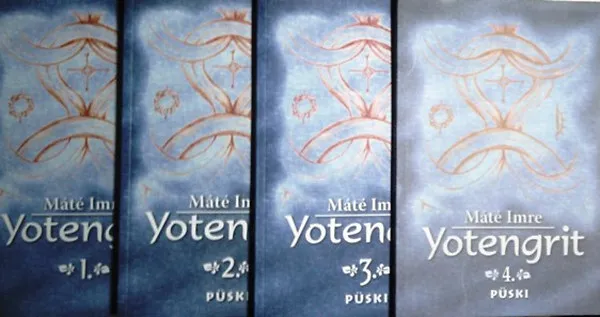
The Yotengrit series represents Máté Imre’s effort to preserve and transmit what he claimed was the spiritual heritage of the rábaközi tudók—the shamans or “knowers” from the Rábaköz region of western Hungary. He published a series of books entitled Yotengrit, in which he explained theology and linguistic etymology.
The work claims to represent the faithful transmission of ancient knowledge preserved by people in the Rábaköz region, the heritage of the so-called “Büün-religion,” which Máté presented as the persecuted original faith of the Hungarians. Unlike purely historical or academic works, the Yotengrit books blend spiritual teaching, mythology, ritual practices, and prophecy into a comprehensive religious-philosophical system.
The volumes include ritual texts, the Tor (a small book of the rábaközi tudós teachings), and the heritage of the mózsiások and tökösök (traditional Hungarian spiritual practitioners). Some volumes even came with CD supplements containing chants and ceremonial recordings, preserving not just the written word but the living practices of this tradition.
The Yotengrit Church: a new-ancient faith
Around 2007, Máté Imre founded the Yotengrit Church, whose complete name is the Church of the Ancient Spirit of the Endless Sea (Tengervégtelen Ős-Szellem Egyháza). This church became one of the most influential organizations within the Hungarian Native Faith movement.
The church was established as a formal institution to preserve and practice what Máté believed was the authentic pre-Christian Hungarian religion. As its bácsa (master), he served as both spiritual leader and theological teacher, guiding followers in the revival of ancient Hungarian spirituality adapted for modern practitioners.
Core theological teachings
This section is a short outline. For the teaching itself — the creation account, the twin vortex, the path back to the All-Good, and what a practice looks like — see Yotengrit and the Old Hungarian Way.
The Primordial God: Yotengrit/Tengrit
At the heart of Máté’s theology lies the conception of a primordial God called Yotengrit, Tengrit, or Tengri, which represents all deities in their yet undivided state. The Hungarian word “tenger” means “sea,” and this represents the primordial undifferentiation from which all existence emerges.
Máté proclaimed the importance of an all-encompassing conception of God, stating: “In this Hungarian religion, it is very important that God is a very abstract concept; a spiritual power. He cannot be simply impersonated; whenever he was impersonated—Gönüz, Ukkó or Boldogasszony—it was always the result of human imagination.”
The Divine Duality
From this primordial unity, God manifests as a male-female duality: Ukkó, the mother goddess whose forehead is decorated by the moon, identified as the Boldogasszony (the “Blessed Lady”) of Christianized folk beliefs; and Gönüz, the sun-faced father god. This divine pairing represents the fundamental cosmic forces that govern existence—the masculine and feminine, solar and lunar, active and receptive principles.
Má-Tun: The National Hero-God
The theology also emphasizes a national god peculiar to the Hungarians—Má-Tun, the deified hero of the folk tale “Fehérlófia” (Son of the White Horse), who was originally a totemic animal ancestor. Máté identified Má-Tun with the historical figure of Maodu, founder of the first Xiongnu empire, and according to his teachings, also founder of the empire of the Huns.
This teaching connects Hungarian identity directly to ancient Central Asian empires, reinforcing the notion of a continuous spiritual and ethnic lineage stretching back millennia.
Spiritual Practices and the Role of the Táltos
Máté Imre positioned himself within the tradition of the táltos—Hungarian shamans who serve as bridges between the earthly and celestial worlds. The táltos tradition, as understood in Hungarian folk belief, involves individuals marked from birth with special signs who undergo spiritual initiations to gain supernatural powers.
Máté founded the church as representative of the ancient Hungarian religion passed down through the unwritten tradition of the tudó (“knower”) people along the Raba river. This emphasis on oral transmission underscored the authentic, living nature of the tradition rather than a purely literary reconstruction.
The practices taught within the Yotengrit tradition would have included ritual ceremonies, healing work, and techniques for entering altered states of consciousness to commune with spiritual forces and ancestors. The preservation of ritual texts in the Yotengrit books ensured these practices could be learned and continued by future generations.
The Prophecy of Nyirka and Political Dimensions
One of the most controversial aspects of Máté’s work is the Prophecy of Nyirka, an allegorical text contained within the Yotengrit books that supposedly forebodes the future of Hungary and global politics. This prophecy has become a touchpoint for nationalist movements and far-right occultism.
However, Máté himself stated that the Yotengrit Church was politically neutral, though he believed its teachings could be a “source of sane, aggression-free national politics.” His vision was apparently one of spiritual renewal leading to healthier national identity rather than political extremism, though interpretations of his work have varied among followers.
A Legacy of Spiritual Renewal
Máté Imre’s greatest contribution was perhaps his role in helping to revive interest in Hungarian indigenous spirituality during a crucial period of post-Soviet cultural renewal. His work provided a framework for Hungarians seeking spiritual connection to their ancestral traditions while navigating the complexities of modern life.
The Yotengrit books remain as his enduring legacy—a bridge between the claimed ancient wisdom of the rábaközi shamans and contemporary seekers of indigenous Hungarian spirituality. Whether viewed as authentic preservation, creative reconstruction, or inspired synthesis, Máté Imre’s work continues to influence the Hungarian Native Faith movement and provides a rich resource for those exploring the spiritual dimensions of Hungarian cultural identity.
Conclusion
Máté Imre walked a remarkable path from revolutionary exile to spiritual teacher, from businessman to bácsa. His life embodied the tensions and possibilities of modern indigenous spirituality—the challenge of preserving ancient wisdom in changing times, the question of authenticity versus adaptation, and the power of spiritual practice to forge community and meaning.
Through the Yotengrit books and the church he founded, Máté offered his people a path back to what he believed were their spiritual roots, teaching that beneath the layers of historical change lay an eternal connection to the divine forces that shaped Hungarian identity. His teachings continue to resonate with those who seek to understand and practice what they believe to be the ancestral faith of Hungary.