In the modern Western world, we have become remarkably skilled at avoiding death. We tuck it behind hospital curtains, hurry through funerals, and offer the bereaved a handful of days before expecting them to return to normal life. Grief, in this model, is a problem to be solved — a storm to be weathered as quickly as possible so that productivity may resume.
But across cultures and throughout human history, something far more profound has been understood: grief is not an obstacle to living. It is one of the most sacred acts of being alive.
Death midwifery — the practice of accompanying the dying and their loved ones through the passage of death — is experiencing a quiet renaissance. And alongside it, ancient mourning rituals from around the world are being reclaimed by people hungry for something more honest, more embodied, and more spiritually nourishing than a three-day bereavement policy. This post explores grief as a spiritual practice, drawing on three distinct traditions and offering a path toward creating meaningful personal rituals for processing loss.
What Is Sacred Grief?
Sacred grief begins with a radical premise: that the pain of loss is not a malfunction, but a doorway. When we love deeply and lose what we love, the shattering that follows is proportional to the depth of that love. To grieve fully is to honor the bond. To rush through it is to dishonor both the dead and the living.
Death midwives — also called end-of-life doulas or death doulas — work in this sacred space. Like birth doulas who support mothers through labor, death doulas support individuals and families through the laboring process of dying. They may help the dying person articulate final wishes, create a meaningful vigil, or simply hold space with unwavering presence. But crucially, their work extends beyond the moment of death into the grief that follows, helping mourners understand that loss is not the end of a relationship but a transformation of it.
This understanding is ancient. Long before clinical psychology gave us the “stages of grief,” cultures around the world had already developed sophisticated, community-rooted rituals for metabolizing loss. Two of the most luminous examples come from Mexico and Tibet.
Día de los Muertos: Death as Reunion
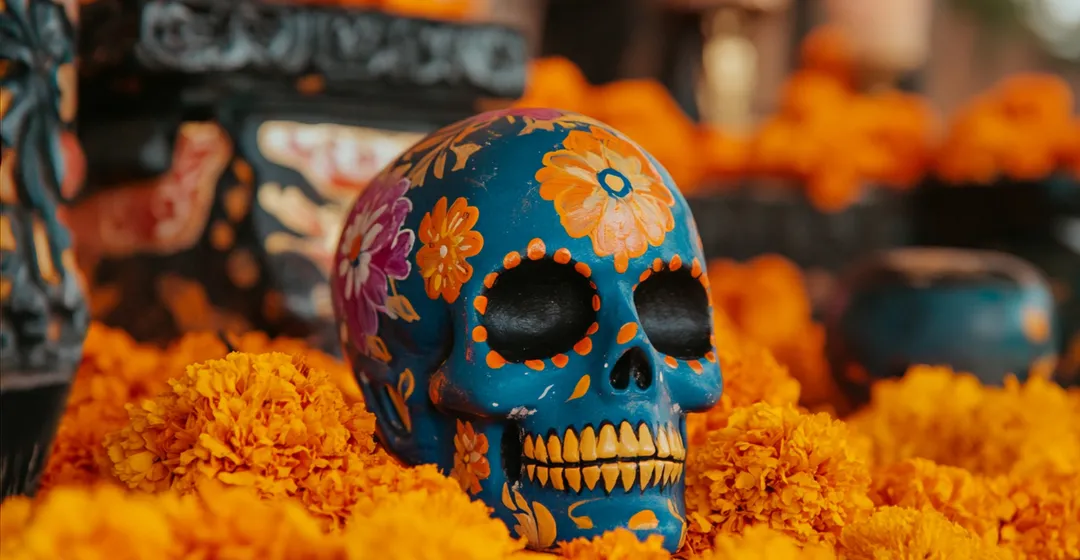
Every year on November 1st and 2nd, Mexican families build ofrendas — elaborate altars adorned with marigolds, candles, photographs, and the favorite foods and objects of their deceased loved ones. Día de los Muertos, rooted in both pre-Columbian Aztec tradition and Catholic influence, holds as its central belief that on these days, the veil between the living and the dead grows thin enough for the departed to return home.
This is not a festival of mourning in the Western sense — there is music, laughter, and feasting. Families gather at gravesites not to weep in isolation but to celebrate in community. Children learn from a young age that death is not a rupture but a rhythm, not an enemy but an ancestor.
The marigold, cempasúchil, is used to create paths of petals from the cemetery to the home — a trail of scent and color to guide the spirits back. Grief, here, is made tangible, sensory, communal.
What Día de los Muertos offers the grieving soul is something profound: continued relationship. The dead are not gone; they are elsewhere. And once a year, we set a place for them at the table. This act of ongoing connection — of speaking to the dead, feeding them symbolically, welcoming them home — is a form of grief work that modern psychology is only recently beginning to validate. Continuing bonds theory, now well-supported in bereavement research, suggests that maintaining an ongoing connection to the deceased is not pathological denial but a healthy and adaptive response to loss.
To grieve in the Mexican tradition is to understand that love does not end at death. It changes form. The ofrenda is a practice of that love made visible.
Tibetan Sky Burials: The Body as Offering
High on the Tibetan plateau, where the frozen earth makes burial impractical and wood for cremation scarce, a different relationship with death has evolved. In the practice known as jhator — sky burial — the body of the deceased is carried to a high, flat rock and offered to vultures, known in Tibetan tradition as Dakinis, or “sky dancers.”
To Western eyes, this can seem shocking. But within Tibetan Buddhist philosophy, the sky burial is an act of profound generosity and spiritual wisdom. The body, understood as an empty vessel once the consciousness has departed, is offered as a final act of charity — feeding living beings. The vultures, far from being sinister, are regarded as sacred carriers, transporting the essence of the deceased toward the heavens.
“The body is like a guesthouse,” the Tibetan Book of the Dead teaches. “The mind is the guest. When the guest departs, what remains is simply an empty room. Offer the room.”
The rituals surrounding the sky burial are elaborate and intentional. Monks chant for days before and after the ceremony, guiding the consciousness of the departed through the bardos — the intermediate states between death and rebirth. Grief is acknowledged, but it is channeled through practice: prayer, meditation, mantra, and the philosophical understanding that death is not an ending but a transition in an endless cycle of existence.
What this tradition offers us is a confrontation with impermanence that is unflinching and even liberating. In Tibetan Buddhism, contemplating death is not morbid — it is considered one of the most essential spiritual practices available to a human being. The Tibetan approach invites us to befriend our mortality rather than flee from it, and in doing so, to live more fully and grieve more wisely.
Creating Personal Mourning Rituals
Most of us will not build an ofrenda this November, nor witness a sky burial on the Tibetan plateau. But the wisdom embedded in these traditions is available to anyone willing to bring intentionality to their grief. The key insight is this: ritual transforms raw pain into meaning. It gives grief a container, a shape, a place to go.
Here are several practices for creating your own sacred mourning rituals, drawn from the cross-cultural wisdom of death midwifery:
Create a Continued Bonds Practice
Following the spirit of Día de los Muertos, designate a space in your home — a shelf, a windowsill, a corner of your desk — as a living altar for your loved one. Place their photograph, an object they cherished, something from nature that reminds you of them. Light a candle there regularly. Speak to them. Write them letters. This is not delusion; it is relationship tended across the threshold of death.
Engage the Body
Grief lives in the body as much as the mind. Tibetan Buddhism understands this intuitively — hence the physicality of prostrations, walking meditation, and the embodied act of the sky burial itself. Find a physical practice to carry your grief: walk the same route you used to walk with them, tend a garden in their honor, practice yoga with their memory held in your heart. Let the body do some of the grieving that the mind cannot fully metabolize.
Mark Time Ritually
Many cultures mark grief in cycles — the Jewish tradition of sitting shiva for seven days, the Mexican tradition of annual return. Consider creating your own temporal anchors: the anniversary of their death, their birthday, the season in which they died. These dates, rather than being dreaded, can become intentional pauses for remembrance. Light a candle. Cook their favorite meal. Gather people who loved them.
Witness and Be Witnessed
One of the most powerful gifts a death doula offers is simply presence — the willingness to sit with another person in their grief without trying to fix or minimize it. Seek out this quality of witness for yourself, whether through a grief circle, a therapist trained in bereavement, or a trusted friend who can hold space without rushing you toward “feeling better.” And offer this same presence to others who are grieving. In community, grief becomes not only bearable but sacred.
Grief as Spiritual Practice
There is a thread running through all of these traditions — Mexican, Tibetan, and the emerging practice of death midwifery — and it is this: grief, when honored rather than suppressed, opens us. It cracks the ordinary shell of our lives and exposes something raw and luminous underneath. It reminds us what matters. It connects us to every human being who has ever loved and lost.
The death midwife understands that grief is not a detour from life. It is one of life’s most profound teachings. When we sit with loss — when we build our altars, speak our prayers, offer our tears to the earth, and allow ourselves to be changed by absence — we are practicing one of the oldest and most transformative arts known to humankind.
We are learning, in the deepest possible sense, how to live.
Going further: Introduction to End-of-Life Doula Training on Udemy is a gentle introduction to the death-doula role, with no prior experience assumed. Affiliate link — Born To Be Free earns a commission if you enrol, at no extra cost to you.