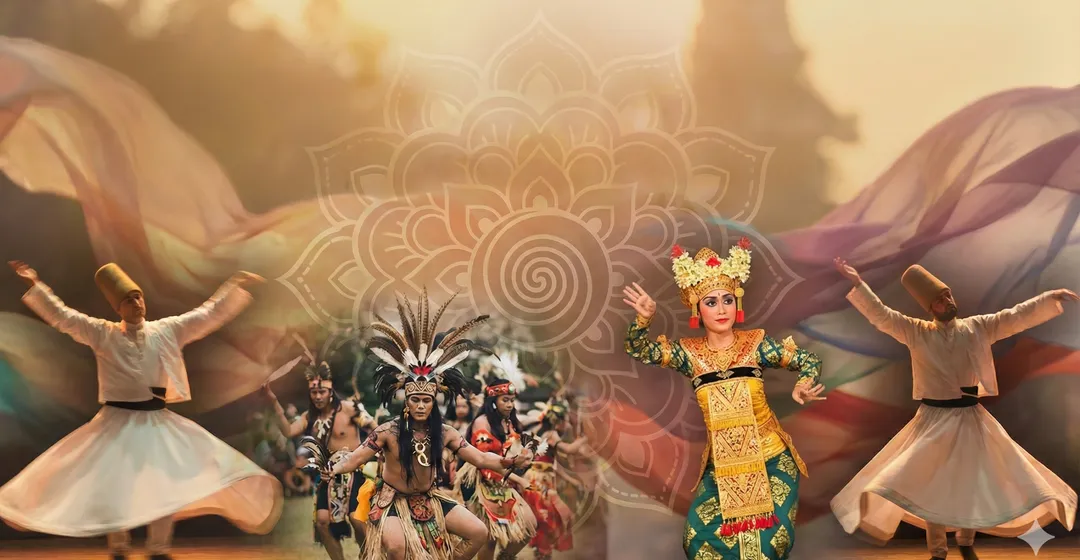
Long before words were written, before temples were built, our ancestors knew a profound truth: the body itself is a gateway to the sacred. Across continents and centuries, human beings have discovered that rhythmic movement can dissolve the boundaries of ordinary consciousness and open doorways to transcendence. From the whirling dervishes of Turkey to the ecstatic dancers of modern spirituality, sacred dance reveals itself as one of humanity’s most ancient and universal forms of prayer.
The whirling path: Sufi dance as union with the divine
In a dimly lit hall, a figure in flowing white robes begins to turn. Slowly at first, then faster, the Sufi dervish spins with one palm raised toward heaven, the other directed toward earth. This is the Sema ceremony, a 700-year-old practice of the Mevlevi Order founded by followers of the Persian poet Rumi. But to call it merely a dance would miss its essence entirely.
The whirling dervish practices what Sufis call “moving meditation,” a kinetic prayer meant to induce a state of divine ecstasy and spiritual ascension. As the body spins, the practitioner aims to shed the ego and earthly attachments, becoming an empty vessel through which divine love can flow. The right hand reaches upward to receive blessings from God, while the left hand turns downward to distribute those blessings to the earth. The dervish becomes a channel, a rotating axis connecting heaven and earth.
The physical effects of sustained spinning are profound. As the vestibular system is overwhelmed, ordinary spatial orientation dissolves. Many practitioners report entering a state where the sense of a separate self fades, replaced by an expanded awareness of unity with all existence. The repetitive circular motion, combined with controlled breathing and inner recitation of sacred phrases, creates a trance state that Sufis describe as experiencing the presence of the Beloved.
Ecstatic dance: freedom as spiritual expression
While Sufi whirling follows precise ritual form, ecstatic dance embraces spontaneity as its sacred principle. This contemporary practice, though rooted in ancient tribal traditions, invites participants to move without choreography, without performance, without judgment. The only rule is to honor your own authentic movement and the space of others.
In ecstatic dance gatherings worldwide, participants create temporary communities of embodied spirituality. The music builds and shifts, carrying dancers through waves of intensity and release. Some move with wild abandon, shaking and leaping. Others sway gently, eyes closed, tracking subtle inner rhythms. Without the need to look good, dance correctly, or impress anyone, participants often report accessing deep emotional releases and spiritual insights.
The practice operates on a simple but powerful premise: the body holds wisdom that the thinking mind cannot access. By surrendering to intuitive movement, dancers bypass the cognitive filters that normally govern behavior. Grief stored in the hips may express itself in rocking motions. Joy might burst forth in spontaneous leaping. Anger can be safely metabolized through stamping and pushing movements. The dance floor becomes a laboratory for emotional alchemy.
Practitioners describe ecstatic dance as “moving meditation” where the motion itself becomes the object of awareness. Rather than sitting still to watch thoughts arise and pass, dancers watch impulses to move arise and follow them. This kinetic mindfulness can induce altered states similar to traditional seated meditation, but accessed through celebration rather than stillness.
Sacred circles: community as container
The circle is humanity’s oldest gathering shape, and circle dances carry that ancient geometry into motion. From the Greek kalamatianos to Bulgarian horo, from Jewish hora to Native American round dances, cultures worldwide have evolved practices of moving together in sacred circles.
These dances serve multiple functions simultaneously. They are social bonding rituals, teaching each generation traditional patterns. They are community celebrations marking seasons, harvests, and holy days. But they are also spiritual technologies that use repetition, rhythm, and collective focus to induce group trance states.
In the modern revival of sacred circle dance, practitioners draw from folk traditions worldwide, dancing Greek, Bulgarian, Israeli, and Kurdish patterns among others. The emphasis is less on cultural preservation and more on experiencing the spiritual essence these dances encode. As dancers move together, stepping the same patterns, breathing together, they often report a palpable sense of group energy or collective consciousness emerging.
The very structure of circle dance creates equality. Everyone can see everyone else. There is no front or back, no hierarchy of importance. The circle makes visible the spiritual truth that all beings are interconnected, each person both leading and following, each individual essential to the whole. When the circle is complete, dancers often experience a sense of containment and safety that allows deeper emotional and spiritual opening.
Movement meditation: the body as prayer
While traditional meditation often emphasizes stillness, movement meditation recognizes that for many people, motion is the path to presence. Walking meditation, qigong, tai chi, and yoga all employ controlled, conscious movement as vehicles for spiritual cultivation.
These practices work with the body’s own wisdom, using breath and motion to quiet the restless mind. In walking meditation, each step becomes an anchor to the present moment. The practitioner experiences the roll of the foot, the shift of weight, the sensation of ground meeting sole. Ordinary walking is transformed into a practice of presence.
Qigong and tai chi take this further, coordinating breath with flowing movements in sequences designed to cultivate and circulate life force energy or “qi.” Practitioners describe feeling energy moving through their bodies, blockages releasing, and a deep sense of integration between body and spirit emerging. The slow, deliberate movements require such complete attention that the chattering mind naturally quiets.
Even in contemporary fitness culture, many people stumble into movement meditation without naming it as such. Runners speak of the “runner’s high,” that state of effortless flow where breath, stride, and heartbeat synchronize into a rhythmic meditation. Swimmers describe the hypnotic quality of repetitive strokes cutting through water. Rock climbers report moments of absolute presence where the entirety of consciousness focuses on the next hand hold.
The rhythm that liberates
What unites these diverse practices is their use of rhythm and repetition to shift consciousness. The human nervous system responds powerfully to rhythmic input. Drumming, chanting, and repetitive movement all have measurable effects on brain wave patterns, often inducing theta waves associated with deep meditation, creativity, and spiritual experience.
This isn’t mystical speculation but observable neuroscience. Rhythmic movement can synchronize neural firing patterns, creating coherence in brain activity. The repetitive nature of many sacred dances allows conscious thought to recede, activating more intuitive, embodied ways of knowing. In this state, practitioners often report insights, visions, or experiences of expanded awareness that would not emerge through verbal or conceptual processes alone.
Indigenous cultures worldwide have always known this. The Kalahari San people dance through the night until the “num” or spiritual energy rises in their spines. Australian Aboriginal peoples use dance to access the Dreamtime. Native American tribes employ rhythmic dancing as a path to vision and healing. These traditions recognize dance as a technology for shifting consciousness, a method as reliable as any pharmaceutical but emerging from the body’s own capacity.
Prayer in motion
Perhaps the deepest wisdom these traditions offer is this: prayer need not be words whispered in silence. The body itself is a prayer. Each movement can be an offering, each gesture a conversation with the sacred. When we dance with intention, with presence, with surrender to something greater than our individual will, we pray in the oldest language humans know.
In our contemporary world, increasingly disconnected from both spiritual tradition and embodied experience, sacred movement practices offer a reunion. They invite us to remember what our ancestors knew: that the path to the divine runs through the body, that transcendence and embodiment are not opposites but partners, that we can think with our whole beings.
Whether spinning like a dervish, moving spontaneously in ecstatic dance, stepping ancient patterns in sacred circles, or simply walking with complete awareness, we participate in a lineage stretching back to the first humans who moved together around a fire. We remember that we are bodies animated by spirit, that the sacred is not somewhere else but right here, in the rhythm of breath, the pulse of heartbeat, the simple miracle of movement itself.
The invitation stands open: to let the body speak its prayers, to trust the wisdom that lives in muscle and bone, to discover through motion what stillness alone cannot reveal. In sacred movement, we find what humans have always found when they dare to dance—freedom, connection, transcendence, and the remembrance that we were always, already, born to be free.
Going further: Personal Transformation via Free-Form Movement & Dance on Udemy is for dancing rather than for facilitating: free-form movement as a practice of your own. Affiliate link — Born To Be Free earns a commission if you enrol, at no extra cost to you.