Before language, before written scripture, before the first temple was built — there was sound. Every culture that has ever existed on this planet discovered, independently and often simultaneously, that certain vibrations can move something inside a human being that words alone cannot reach. Whether it was the resonant hum of a Tibetan singing bowl in a mountain monastery, the polyphonic harmonies of Gregorian monks echoing through stone walls, the repetitive pulse of a shamanic drum in the Siberian tundra, or the sacred syllable Om rising from a thousand yogic throats at once — the intuition was always the same: sound is not merely something we hear. It is something we become.
This article explores that ancient intuition across traditions — and asks what modern science, together with lived practice, can tell us about why vibrational healing through sacred sound actually works.
The Physics Beneath the Practice
To understand sound healing, it helps to start with a simple fact: everything vibrates. Your cells, your organs, the fluid in your ears, the bones in your skull — all of it oscillates at specific frequencies. Sound, in its most basic definition, is the transmission of those oscillations through a medium. When you strike a singing bowl or intone a mantra, you are not merely producing noise. You are introducing a coherent vibrational pattern into an environment — including the body of anyone within range.
The principle that explains much of what sound healers describe is called entrainment: the tendency of weaker oscillations to synchronize with stronger, more coherent ones. You experience this every time your foot taps automatically to a steady beat. At the neurological level, research has shown that certain sound frequencies can shift brainwave activity from high-alert beta states down into calming alpha and theta states — the same states associated with deep meditation, creative flow, and emotional processing. A 2016 study published in the Journal of Evidence-Based Integrative Medicine found that a single session of singing bowl meditation significantly reduced participants’ tension, anger, fatigue, and depression, while increasing their sense of spiritual well-being.
Sound healing may also stimulate the vagus nerve — the body’s primary channel for the parasympathetic “rest and digest” response. If you’ve ever felt an involuntary wave of calm wash over you during a deep chant or a resonant gong bath, that’s likely not placebo. It’s your nervous system responding to vibration through pathways that predate conscious thought. (For a deeper exploration of the vagus nerve’s role in inner states, see our article on The Vagus Nerve: Your Body’s Gateway to Higher States.)
Tibetan Singing Bowls: Resonance as Medicine
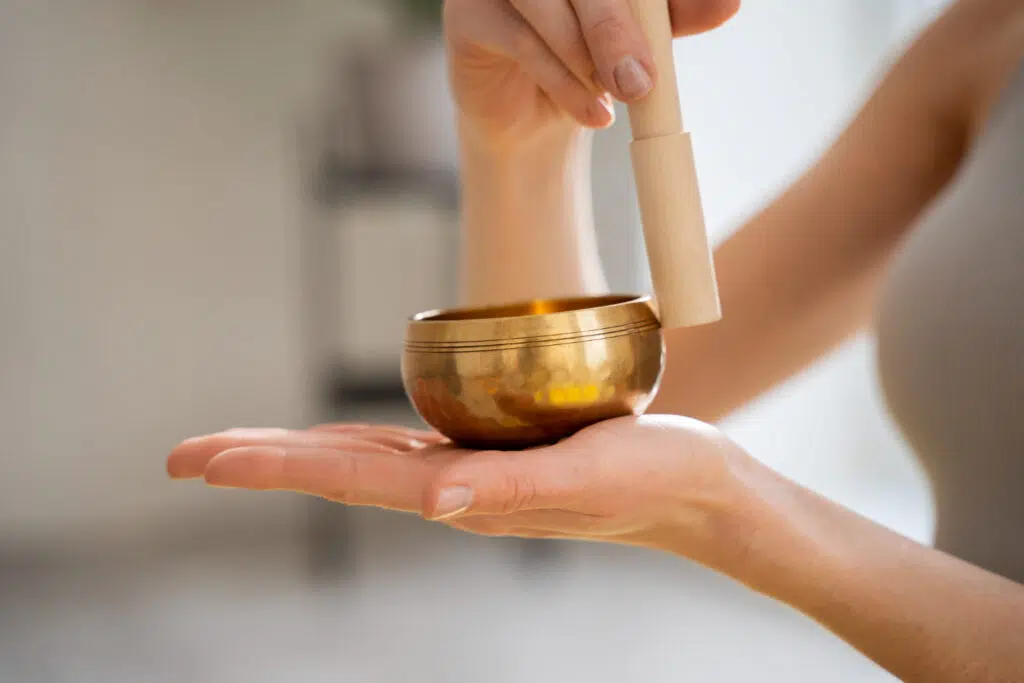
The Tibetan singing bowl — or more accurately, the Himalayan singing bowl, since these instruments originate from a broad region spanning Tibet, Nepal, and Bhutan — is perhaps the most globally recognized tool of sound healing today. Traditionally cast from an alloy of multiple metals (some accounts say five to seven), these bowls produce complex, layered overtones when struck or circled with a mallet. The sound is never clean or simple. It shimmers, spreads, and seems to take up more space than any single note should.
In traditional Tibetan Buddhist practice, bowls were used to mark meditation sessions, signal transitions in ritual, and help practitioners enter altered states of concentration. The bowl’s sound was understood not as entertainment but as an active agent — something that clears the energetic field and prepares the mind for inward work.
In contemporary sound bath settings, participants lie down while practitioners place bowls on or near the body and play them continuously. The vibrations are not only heard but felt — particularly when bowls are placed directly on the sternum, abdomen, or the soles of the feet. This tactile dimension matters: the body receives the healing as much through touch as through hearing.
Gregorian Chant: Resonance in Stone
On the other side of the world, medieval Christian monks in European monasteries arrived at a strikingly similar understanding through an entirely different cosmological framework. Gregorian chant — the monophonic, unmetered sacred song of the Roman Catholic tradition — was developed and codified between roughly the 6th and 9th centuries CE. Its purpose was explicitly spiritual: to attune the singer (and listener) to the divine.
What makes Gregorian chant remarkable from a vibrational standpoint is its acoustic context. Gothic and Romanesque churches, with their high stone vaulted ceilings and dense walls, were not passive containers for sound — they were instruments in themselves. The architecture was designed to produce reverb times of eight seconds or more, meaning a single note would continue resonating long after it had been sung. Monks chanting in these spaces were not hearing their own voices so much as being surrounded by their own voices, swimming in overlapping layers of harmonic resonance.
Modern research on Gregorian chant has found measurable physiological effects: reduced heart rate, lowered blood pressure, and increased synchronization between cardiac and respiratory rhythms. Some neurologists have noted that the long, slow phrases of chant naturally encourage extended exhalations — which in turn activate the parasympathetic nervous system. Millennia before anyone understood the vagus nerve, Benedictine monks had intuitively built its stimulation into their daily practice.
Mantra and the Yoga of Sound
In the Hindu and yogic traditions, sound is not merely therapeutic — it is cosmological. The universe itself is said to have begun with sound: Nada Brahma, the world is sound. The Sanskrit mantra tradition is one of the most elaborately developed systems of vibrational healing in human history, with thousands of years of experimentation behind it.
Mantras are typically short syllables, words, or phrases that are repeated rhythmically — either aloud, in a whisper, or silently in the mind. The most universal of these is Om (or Aum), which is understood to contain all possible sounds and to resonate with the fundamental frequency of existence itself. When chanted slowly, Om produces vibrations in the chest, throat, and skull that are quite literally felt as much as heard.
Beyond Om, the bija (seed) mantras associated with the seven chakras offer a structured system for directing vibrational healing to specific areas of the body and corresponding emotional or psychological domains. LAM for the root chakra (grounding, safety), VAM for the sacral (creativity, desire), RAM for the solar plexus (will, confidence), YAM for the heart (love, compassion), HAM for the throat (expression, truth), OM for the third eye (intuition), and a high AH or silence for the crown (transcendence). The system maps remarkably well onto the anatomical regions of the body and the psycho-emotional patterns associated with each. For a full exploration of how the chakra system relates to energy movement along the spine, see our piece on The Spine as Axis Mundi: Kundalini, Alchemy, and Spinal Health.
Mantra practice is also one of the more accessible entry points into sound healing — requiring no instruments, no special acoustics, and no particular skill beyond willingness and consistency. Twenty minutes of daily Om chanting has been shown in clinical studies to reduce cortisol levels, slow respiration, and increase alpha brainwave activity.
Indigenous Drumming: The Oldest Heartbeat
Long before any of the above traditions formalized their practices, indigenous peoples around the world were using rhythmic percussion — particularly drumming — as their primary tool of healing and spiritual navigation. From Siberian shamanism to Native American ceremony, from West African drumming traditions to Celtic and Nordic ritual, the drum appears everywhere as the central instrument of transformation.
The reasons are both practical and physiological. A drum at 4–7 beats per second produces sound in the theta brainwave frequency range — the very state associated with hypnagogic imagery, deep emotional processing, trauma integration, and shamanic journeying. Anthropological research has consistently found that shamanic drumming induces altered states of consciousness in practitioners and participants alike, states in which emotional blocks can surface and dissolve, and in which the ordinary boundaries of the self become more permeable.
What is particularly striking is that this was arrived at without any of the technological measurement we use today to verify it. The people who developed these practices learned through direct experimentation across many generations what certain rhythmic patterns do to human consciousness — and they encoded that knowledge in ritual forms that have survived for tens of thousands of years.
The drum is also the most directly physical of healing sounds. Its low-frequency pulses travel through the body in ways that higher-pitched sounds cannot. In many traditions, the drum is understood as the heartbeat of the Earth — and in placing yourself within its rhythm, you are, at least metaphorically and arguably physically, synchronizing yourself with something larger than your individual nervous system.
Binaural Beats: Technology Meets Ancient Knowing
The most recent addition to the toolkit of vibrational healing is the binaural beat — a technology, not a tradition, though it draws on the same fundamental principle of entrainment. When two slightly different frequencies are played simultaneously in different ears (one at 200 Hz, say, and the other at 207 Hz), the brain perceives a third, phantom frequency equal to the difference between them — in this case, 7 Hz, which falls in the theta range.
Unlike singing bowls or mantras, binaural beats require headphones and electronic audio equipment. They produce no overtones, no warmth, no ceremonial context. What they do offer is precision and accessibility: specific brainwave states can be targeted with measurable consistency, making them useful for sleep induction, focus enhancement, anxiety reduction, or meditation deepening.
The limitation of binaural beats is also the limitation of any purely technological approach: they bypass the active, participatory dimension of healing. Chanting a mantra engages your breath, your attention, your intention, and your voice. Playing a singing bowl demands embodied presence. Drumming connects you to a communal rhythm. Binaural beats, at their best, create favorable neurological conditions — but the work of healing still requires the person to show up and use those conditions.
What the Traditions Share
Across all of these very different cultural expressions, several threads are consistently present:
Repetition and rhythm — Whether it’s the cycling of a mantra, the steady beat of a drum, or the sustained resonance of a bowl, healing sounds are almost never one-time events. They create rhythmic patterns that the nervous system can lock onto and follow down into deeper states.
Intentionality — Sacred sound traditions universally treat the practitioner’s inner state as inseparable from the sound being produced. A mantra chanted with a scattered, distracted mind produces something categorically different from the same mantra chanted with full presence and devotion. The vibration and the intention travel together.
Communal resonance — Many of the most powerful sound healing traditions are inherently collective. Gregorian chant in community, indigenous drumming circles, group kirtan (devotional chanting) — the fact that many voices or instruments are vibrating together creates a field effect that solo practice cannot replicate. When you chant in a group, you are not just hearing sound. You are swimming in a shared vibrational field that you are simultaneously creating.
The body as the instrument — In every tradition considered here, the body is not a passive receiver of healing sound but an active participant. The chant moves through your chest. The bowl vibration enters through your skin. The drum pulse reorganizes your heartbeat. Sound healing is an embodied practice, not a mental one.
How to Begin
You don’t need a monastery, a sacred geography, or years of training. The simplest entry points are also among the most powerful:
- Daily Om chanting — Five to ten minutes every morning, with attention placed on where in the body you feel the vibration. Let it shift from day to day.
- Sound bath attendance — Many yoga studios and wellness centers now offer regular sound bath sessions with singing bowls or gongs. Even a single session can offer a direct, felt sense of what vibrational healing means.
- Binaural beats for meditation support — Use theta-frequency binaural beats (freely available on YouTube and Spotify) during seated meditation, with headphones, to deepen your sessions while you develop practice consistency.
- Explore your own tradition — If you have a religious or cultural background that includes sacred music — whether Sufi qawwali, Gospel, Gregorian chant, or Vedic chanting — revisit it with fresh ears. The vibrational intelligence encoded in those traditions is real, and it belongs to you.
Sound healing, at its deepest level, is a return to something the body already knows. Before the conceptual mind was trained to locate healing in diagnosis and remedy, human beings trusted that certain vibrations could reorganize disordered states — emotional, physical, energetic — back toward coherence. The traditions that survived are not historical curiosities. They are operating manuals for the human instrument.
The question is simply whether you are willing to play it.
References: