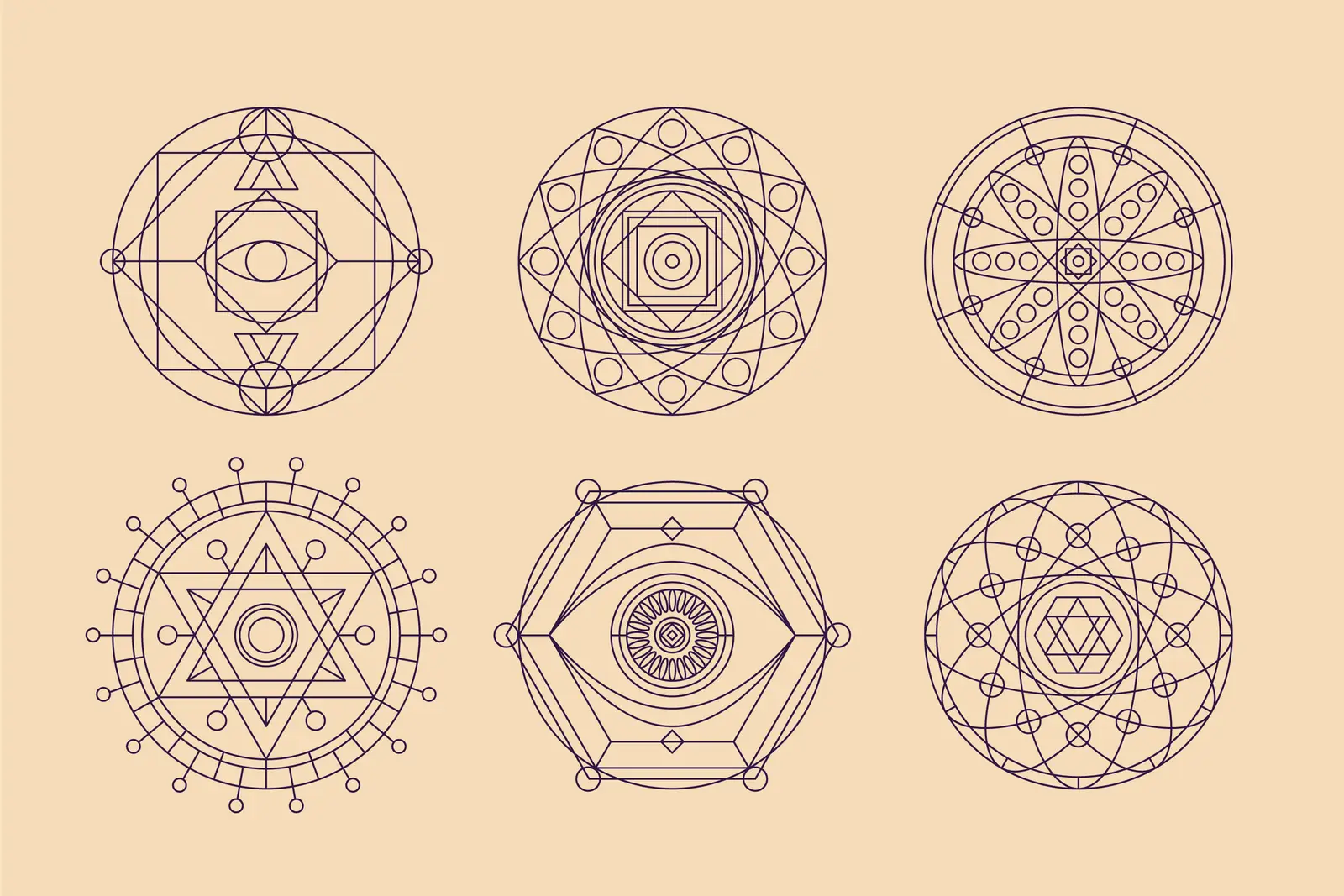
There is a page of seven laws that circulates endlessly through esoteric corners of the internet, usually presented as the secret teaching of ancient Egypt, handed down from Hermes Trismegistus himself.
The teachings behind them are genuinely old. This particular list is not.
The seven principles come from The Kybalion, published in Chicago in 1908 by three anonymous authors, and attributed with reasonable confidence to William Walker Atkinson, a prolific New Thought writer. It is a modern distillation, dressed in antique clothing, of themes that do run through the real Hermetic literature.
Saying so is not a debunking. It is the first useful thing anyone can tell you about the book, because it explains both its strengths — it is clear, ordered and practical in a way the ancient material almost never is — and its weaknesses, which are the weaknesses of 1908 American self-improvement thinking. Read as a nineteenth-century mind’s honest attempt to systematise Hermeticism, it is genuinely valuable. Read as a lost Egyptian scripture, it will teach you things that are not true.
Where the book actually came from
The Kybalion appeared in 1908 from the Yogi Publication Society in Chicago, credited to “Three Initiates” and dedicated to Hermes Trismegistus. No author has ever been confirmed, but the attribution to William Walker Atkinson is about as solid as anonymous authorship allows: he ran that publisher, he wrote at industrial volume under at least three pen names, and the prose, the structure and the preoccupations are all recognisably his.
Atkinson belonged to New Thought — the American movement, roughly 1880–1920, that held mind to be causative over matter and health. It is the same current that produced Christian Science and, further downstream and much diluted, the twentieth-century positive-thinking industry.
That lineage explains the book’s texture completely. Its confidence, its brisk numbered structure, its insistence that these are laws in the way physics has laws, its faith that a diligent student can master reality by understanding principles — none of that is Egyptian. It is turn-of-the-century American optimism, and it is why the book is so much tidier than anything genuinely ancient.
What the real Hermetica are like
The actual Hermetic literature — the Corpus Hermeticum, the Asclepius, the Emerald Tablet, compiled in Greek-speaking Egypt in roughly the first three centuries CE — is nothing like a list of seven laws.
It is dialogue, vision and initiation. Hermes instructs a student; the student fails to understand; there is rebirth, silence, and passages of ecstatic praise. The universe it describes is alive and hierarchical, full of intermediary powers. Where the Kybalion offers principles to apply, the Hermetica offer an experience to undergo — and rarely explains itself.
Does the Kybalion misrepresent it? Partly. Mentalism, Correspondence and Vibration have genuine roots in that material. Polarity, Rhythm and Gender as stated laws are largely Atkinson’s own systematising. And the whole framing — reality as a set of masterable rules — is closer to New Thought than to a tradition whose central move was surrender to something vastly larger than you.
Which is worth knowing before you spend a year on it. The Kybalion is a nineteenth-century mind’s honest, useful map of an older country. Just do not mistake the map for the country.
What follows is each principle: what the text says, what it means, the misreading almost universally attached to it, and one practice to test it with.
1. Mentalism
“THE ALL is MIND; The Universe is Mental.”
The founding claim: reality is not fundamentally made of matter that somehow produces minds, but of something mind-like, in which matter appears. Philosophy calls the neighbourhood idealism, and it has serious defenders — Berkeley in the eighteenth century, and a live minority position in philosophy of mind today.
The misreading: that this is a manifestation technique — think hard enough and reality rearranges itself around you. That reading turns a metaphysical claim about the nature of the cosmos into a claim about personal leverage over it, which is nearly the opposite. If THE ALL is mind, your individual mind is a small eddy inside something vast, not its operator.
The honest version is stranger and more interesting: you are not outside reality manipulating it, you are made of the same stuff it is.
Practice. Once a day, catch the moment a mood changes what you are looking at — the same street after good news and after bad. You are not observing that the street changed. You are observing that “the street” was never separable from the mind meeting it.
2. Correspondence
“As above, so below; as below, so above.”
Patterns repeat across scales. What is true of the largest is echoed in the smallest, so a structure you can examine tells you something about one you cannot.
This is the one principle the Kybalion did not invent — the phrase is lifted directly from the Emerald Tablet, whose verse-by-verse reading covers the original in depth.
The misreading: that it licenses any correspondence you like. Correspondence is a heuristic, not a proof — it suggests where to look, and it cannot establish what you find. Used carelessly it becomes a machine for confirming whatever you already believed, since with enough freedom any two things can be made to rhyme.
Practice. Take one recurring conflict in your outer life. Ask, without deciding in advance, where the same shape appears in your inner life. Not as a moral — as a structural observation. Then let it sit.
3. Vibration
“Nothing rests; everything moves; everything vibrates.”
Everything is in motion, and what distinguishes one thing from another is its rate of motion. Applied inwardly: mental and emotional states are not fixed objects but frequencies, and frequencies can be changed.
The misreading: the wellness-industry version — “raise your vibration” — which borrows the vocabulary of physics to describe a mood. The Kybalion is not making a claim about hertz. Treating it as literal physics is how a workable psychological insight becomes pseudoscience, and it is the fastest way to lose an audience that would otherwise listen.
Practice. Name your current state precisely — not “bad”, but restless, flat, braced. Then act on the body, since it is the accessible end: breathe deliberately, walk, or chant. Notice that the state moved when you stopped arguing with it and changed its conditions instead.
4. Polarity
“Everything is Dual; everything has poles… opposites are identical in nature, but different in degree.”
Hot and cold are one thing — temperature — measured at different points. Love and hate are one thing, degrees along a single axis, which is why they convert into each other so readily and why indifference, not hatred, is love’s actual opposite.
The practical consequence is the Kybalion’s most useful idea: you cannot destroy a state, but you can move it along its own scale. Fear does not become courage by being fought; it moves toward courage by degrees.
The misreading: that if opposites are one, nothing is really bad — a short step to spiritual bypassing, where cruelty gets excused as “just a lower vibration of love”. Degree is not the same as equivalence. A burn and a warm bath are the same axis; only one of them injures you.
Practice. Take something you are avoiding. Name the pole you are at — dread. Name the far pole — ease. Then ask what one degree of movement looks like, not the whole journey. One degree is almost always available.
5. Rhythm
“Everything flows, out and in; everything has its tides; all things rise and fall.”
The pendulum swings. Every high has a corresponding low, every expansion a contraction, and the swing is not a malfunction but the shape of how things move — in seasons, in economies, in enthusiasm for a practice you were sure would last.
The Kybalion’s addition is the Law of Neutralisation: you cannot stop the pendulum, but you can decline to ride it all the way, by holding a stable point while the swing happens.
The misreading: fatalism dressed as wisdom — “everything happens for a reason”, used to avoid acting. Rhythm describes a pattern; it does not excuse you from the part you play in it.
Practice. When enthusiasm for something is high, write down what you will do when it drops — because it will, and your future self will not be able to reconstruct today’s reasons. This is what makes a practice survive its third week, which is where most meditation practices die.
6. Cause and Effect
“Every Cause has its Effect; every Effect has its Cause; there are many planes of causation, but nothing escapes the Law.”
Nothing is uncaused. What looks like chance is causation you cannot yet see. The text’s practical aim is to move a person from being an effect — pushed by moods, inherited reactions, other people’s states — toward being a cause.
The misreading, and it is the ugliest of the seven: that people cause everything that happens to them. That reading turns a principle about agency into a tool for blaming the ill for their illness and the poor for their poverty. The Kybalion explicitly allows for many planes of causation, most of which run straight through you and have nothing to do with you.
Practice. In any reaction today, find the link before your reaction. Not to assign blame — to see the chain. Agency begins exactly where the chain becomes visible, and not one link earlier.
7. Gender
“Gender is in everything; everything has its Masculine and Feminine Principles.”
Two functions appear in every process: one that initiates, projects, and gives form; one that receives, gestates, and brings forth. The Kybalion calls them Masculine and Feminine, and is unusually explicit that this is not about sex — it distinguishes gender from sex directly, and locates both principles in every person and every thing.
Think of any creative act. Something proposes; something else receives and develops it. Neither half produces anything alone.
The misreading: reading it back onto people, so that men are “naturally” initiating and women “naturally” receptive. This inverts the principle, which says both are present everywhere. A century of essentialism has been justified with a passage that argues against it.
Practice. In your own work, notice which function you default to. Chronic initiating without receiving produces output nobody wanted; chronic receiving without initiating produces nothing at all. The correction is whichever one you flinch from.
The seven at a glance
| # | Principle | The claim | The usual misreading |
|---|---|---|---|
| 1 | Mentalism | reality is mind-like at bottom | a manifestation technique |
| 2 | Correspondence | patterns repeat across scales | proof rather than a hint |
| 3 | Vibration | everything moves; states have rates | literal physics, “raise your vibration” |
| 4 | Polarity | opposites are degrees of one thing | nothing is really bad |
| 5 | Rhythm | everything swings; you can hold a centre | fatalism, “meant to be” |
| 6 | Cause and Effect | nothing is uncaused; move from effect to cause | you caused everything that happened to you |
| 7 | Gender | every process initiates and receives | claims about men and women |
A week to test them
Reading these changes nothing. Seven days, one principle each, costs almost nothing and settles the question.
| Day | Principle | What to actually do |
|---|---|---|
| 1 | Mentalism | Catch one moment where a mood changed what you saw. |
| 2 | Correspondence | Find one outer conflict whose shape repeats inwardly. |
| 3 | Vibration | Name a state precisely, then change its physical conditions. |
| 4 | Polarity | Take one dread and move it a single degree. |
| 5 | Rhythm | Write the instruction your low-energy self will need. |
| 6 | Cause and Effect | Find the link immediately before one reaction. |
| 7 | Gender | Notice whether you default to initiating or receiving. |
Keep a line of notes each day. At the end, some of these will have earned their place and some will not have come up at all — and that result is worth more than agreeing with all seven.
What to do with all seven
The Kybalion’s own instruction is to treat these as keys rather than conclusions. That is good advice, and it points at the difference between reading the book and using it.
A principle you merely agree with changes nothing. A principle you test — for a week, against something real — either earns its place or quietly stops coming up. Both outcomes are worth having.
Start with Polarity, which is the most immediately useful of the seven, and Rhythm, which is the one that keeps a practice alive long enough for the others to matter.
And keep the dating straight. The Hermetic tradition is genuinely ancient, genuinely strange, and considerably deeper than any list of seven laws — the Emerald Tablet is where to meet the older material, and the convergences between Eastern and Western esoteric traditions are where it gets genuinely surprising. The Kybalion is a good door. It is not the building.
Going further: Code X with Robert Grant on Gaia works through the hermetic and geometric material this article only opens.
Or, as a course: Living in Alignment with the 7 Universal Principles on Udemy takes the same seven principles and asks what living by them looks like day to day. Affiliate link — Born To Be Free earns a commission if you subscribe or enrol, at no extra cost to you.